Welcome: Laizhou Machinery Group



An expandable event trailer can create a large enclosed venue in a relatively short time.
But once 100, 150 or more guests enter the space on a hot summer afternoon, one question becomes critical:
Can the HVAC system actually keep the venue comfortable?
This is particularly important for buyers planning projects in hot U.S. markets such as:
Texas
Florida
Arizona
Nevada
Southern California
For wedding venues, event rental companies and corporate hospitality operators, insufficient air conditioning is not a minor technical inconvenience.
It can affect the entire event.
Guests become uncomfortable.
Doors are opened more frequently.
Staff receive complaints.
The customer remembers the temperature instead of the venue.
For this reason, HVAC capacity should be calculated from the actual project conditions, rather than selecting a fixed number of air conditioners simply according to trailer length.
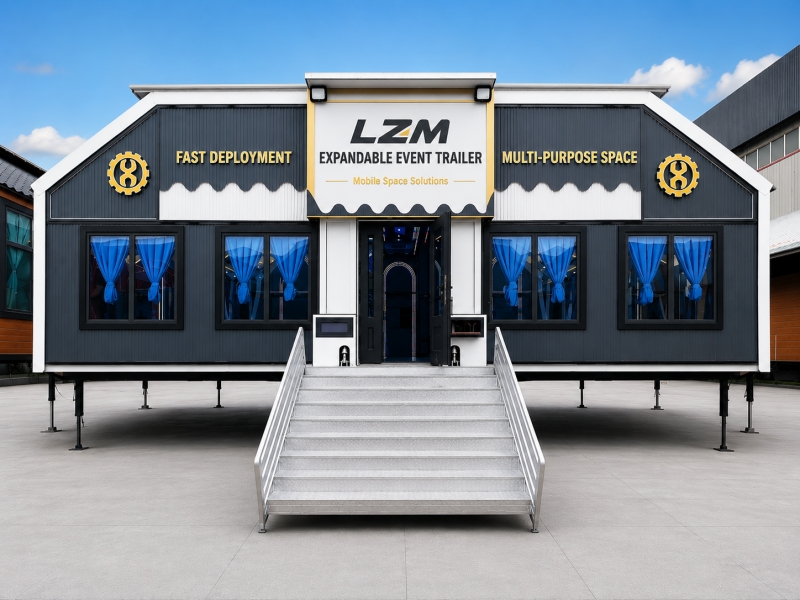
A buyer may ask:
“How many air conditioners does a 15m expandable event trailer need?”
There is no responsible universal answer.
Two 15m trailers can have very different cooling requirements.
For example, Trailer A may operate:
In a mild climate
Mainly at night
With limited glass
With 80 guests
Trailer B may operate:
In Houston in July
During afternoon events
With large glass walls
With 180 guests
Although their physical dimensions are similar, their cooling loads are not.
HVAC should therefore be based on the complete operating scenario.
Several variables influence how much cooling the venue requires.
The most important include:
Indoor Volume
Outdoor Temperature
Guest Count
Solar Heat Gain
Glass Area
Insulation
Lighting
AV and Catering Equipment
Door Opening
Each adds heat to the venue or makes it harder to remove heat.
It is tempting to say:
“The outside temperature is 35°C, so design the air conditioning for 35°C.”
But actual HVAC engineering is more complicated.
A trailer sitting under strong direct sunlight can absorb substantial additional heat through:
Roof
Walls
Glass
Surface temperatures may be considerably higher than the surrounding air temperature.
This is why solar exposure matters.
Both cities can experience demanding summer conditions.
But their climates are not identical.
Houston combines high temperatures with substantial humidity.
Phoenix typically experiences much drier conditions but very high daytime temperatures.
These differences affect:
Sensible cooling
Dehumidification
Guest comfort
Equipment selection
A cooling system should therefore be configured for the destination environment rather than simply labeled:
“Suitable for hot weather.”
Guests can feel uncomfortable even when the displayed indoor temperature appears acceptable.
High humidity can make a venue feel:
Sticky
Heavy
Warmer than expected
This is especially relevant in:
Florida
Gulf Coast states
Other humid climates
An HVAC system needs to address both:
Temperature
and
Moisture.
Simply installing extremely high airflow without appropriate humidity control does not necessarily create a comfortable ballroom.
In a hot, dry climate, humidity may not be the dominant concern.
Instead, the equipment may need to handle very high sensible heat loads.
Solar gain can become substantial.
This is why an HVAC configuration suitable for one U.S. climate zone should not automatically be copied into another.
Every person inside the venue produces heat.
A nearly empty trailer and a fully occupied wedding reception therefore behave very differently.
Imagine testing the air conditioning at the factory.
The venue is empty.
The interior cools quickly.
The buyer thinks:
“Perfect.”
Then 180 guests arrive at the first wedding.
Now the room contains 180 additional heat sources.
The cooling system has to manage that load continuously.
This is why factory testing without considering real occupancy can create false confidence.
A seated corporate presentation and a wedding dance floor do not create identical conditions.
Guests who are:
Dancing
Moving
Standing closely together
can generate a greater cooling challenge than seated guests.
For wedding and party applications, the HVAC calculation should consider the actual activity level.
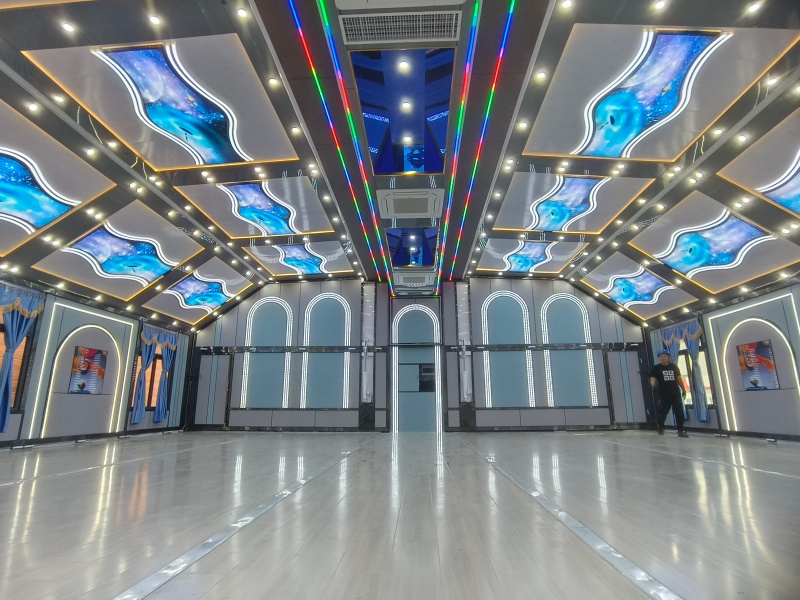
Modern LED lighting is much more efficient than older systems.
But lighting still contributes heat.
Large event venues may include:
Ceiling lighting
Decorative lighting
Spotlights
Stage lighting
Exterior lighting
The effect of each individual fixture may appear small.
Together, they contribute to the internal heat load.
Many corporate and brand events use large LED screens.
Wedding customers may also request:
LED video walls
Digital displays
Large televisions
These systems consume electricity.
A portion of that electrical energy ultimately becomes heat inside the venue.
A heavily equipped corporate event may therefore require different HVAC planning from a simple banquet layout.
Professional AV systems may include:
Amplifiers
Processing equipment
Computers
Control equipment
These are another source of internal heat.
The HVAC designer should know whether the trailer will regularly support substantial event-production equipment.
Food service deserves special attention.
There is a major difference between:
Prepared food arrives from an external kitchen.
and:
Cooking equipment operates inside the trailer.
Internal equipment such as:
Ovens
Grills
Refrigeration
Warming equipment
can add significant thermal load.
Cooking can also introduce:
Moisture
Odor
Ventilation requirements
A full commercial kitchen should therefore be treated as a dedicated design issue.
For a hotel or resort project, it may make more sense to use an existing permanent kitchen.
The expandable trailer then functions mainly as:
Banquet / Dining / Event Space
instead of duplicating a full kitchen.
This can reduce:
HVAC load
Electrical demand
Weight
Interior-space consumption
The business model and HVAC design are directly connected.
Large glass sections are popular for luxury wedding venues.
They can create:
Natural light
Garden views
Resort atmosphere
Premium appearance
But glass can also increase solar heat gain.
This becomes particularly important when the glass faces strong afternoon sun.
A luxury wedding trailer with extensive glazing may therefore require different cooling capacity from a trailer with more insulated wall area.
Consider two identical trailers at the same property.
Trailer A has its largest glass area facing the intense afternoon sun.
Trailer B is oriented differently.
Their cooling challenge can be different.
For long-term installations, orientation should be considered during site planning.
Where practical, the site design can reduce unnecessary solar loading.
This creates an engineering trade-off.
Customers may want:
More Glass
for appearance.
At the same time, they want:
Lower HVAC Cost
and:
Maximum Cooling Performance.
These goals can conflict.
The correct design balances:
Appearance
Thermal performance
Equipment capacity
Energy consumption
rather than maximizing one feature without considering the others.
The building envelope plays a major role in climate control.
Wall and roof systems can help reduce heat transfer between:
Hot exterior
Conditioned interior
Better thermal performance can reduce the amount of heat the HVAC system needs to remove continuously.
For a commercial event venue operating frequently, insulation can therefore affect not only comfort but operating cost.
The roof receives substantial solar exposure.
In hot sunny markets, roof heat gain can become significant.
A beautiful interior ceiling does not automatically mean the roof has good thermal performance.
Buyers should distinguish between:
Interior Decoration
and
Thermal Construction.
Both matter, but they perform different functions.
Metal structures can transfer heat efficiently.
A well-designed insulated wall still contains:
Frames
Connections
Structural members
that can influence overall thermal performance.
For demanding climates, the complete wall and roof assembly should be considered rather than discussing only insulation thickness.
A powerful air-conditioning system cannot operate efficiently if conditioned air constantly escapes through:
Poor seals
Expansion joints
Doors
Service openings
Air leakage also allows hot humid outside air to enter.
Sealing quality therefore affects HVAC performance directly.
Unlike a conventional fixed building, an expandable trailer contains moving sections.
After deployment, those interfaces need to form an effective enclosure.
Proper seals help control:
Rain
Dust
Air leakage
Temperature
Maintaining these seals is part of long-term HVAC performance.
Imagine a perfectly insulated venue.
Now keep the main entrance open for twenty minutes while guests arrive.
A large quantity of outside air enters.
In Houston, that may mean:
Hot air
Humid air
The HVAC system then has to recover.
Door management therefore has a surprisingly large effect on comfort.
Before guests arrive, the venue may be pre-cooled.
Then suddenly:
Doors open repeatedly
150 people enter
Staff move equipment
Catering begins
Lighting turns on
The thermal load increases rapidly.
HVAC should be designed for demanding operational periods, not only steady-state empty-room conditions.
An operator should not wait until guests arrive to start the air conditioning.
Where practical, the venue can be conditioned in advance.
This allows:
Interior surfaces to cool
Humidity to reduce
Comfortable conditions before occupancy
Pre-cooling can be especially important for afternoon summer weddings.
Another useful question is:
How quickly can the venue recover after doors have been open?
Cooling capacity that can merely maintain the temperature under ideal conditions may struggle after a large heat gain.
Some reserve capacity can improve recovery.
However, simply oversizing equipment dramatically can create other problems.
It might seem logical that if 20 kW is good, 40 kW must be better.
Not necessarily.
Severely oversized equipment can:
Cycle inefficiently
Create temperature fluctuations
Provide inadequate dehumidification in some systems
Increase electrical demand
Increase purchase cost
Correct sizing is more important than maximum sizing.
A project can use recognized cooling-load calculation methods based on factors such as:
Building envelope
Indoor dimensions
Outdoor design conditions
Occupancy
Lighting
Equipment
Ventilation
For demanding projects, the final calculation should be reviewed by a qualified HVAC professional familiar with the destination market.
A request such as:
“15m trailer, please quote.”
is incomplete.
For HVAC planning, it is much more useful to know:
“15m wedding event trailer for Houston, Texas.”
or:
“19m banquet venue for Phoenix, Arizona.”
The destination immediately provides useful climate context.
This is one reason customized expandable event trailers cannot always be treated as identical standard products.
The manufacturer should also know whether the buyer expects:
80 guests
150 guests
250 guests
The same physical trailer can be configured for different event densities.
Higher occupancy can increase:
Heat load
Ventilation requirements
Electrical requirements
Capacity information therefore affects both layout and mechanical design.
Air conditioning controls temperature and often humidity.
Ventilation introduces outdoor air.
These are related but separate functions.
A venue occupied by a large number of people needs appropriate consideration of indoor-air quality.
Simply recirculating the same indoor air indefinitely is not the same as providing ventilation.
Introducing outside air is necessary in many occupied-space designs.
But in a hot climate, that outdoor air must be:
Cooled
and, in humid climates:
Dehumidified.
The more outside air introduced, the greater the cooling load.
HVAC sizing must therefore balance:
Indoor Air Quality
with
Thermal Performance.
Ventilation requirements can depend on:
Occupancy
Application
Local code
For U.S. projects, buyers should work with appropriately qualified local professionals where required.
The overseas manufacturer can provide equipment and technical information, but final installation and compliance need to match local requirements.
Imagine installing powerful air conditioners at one end of a 21m venue.
Guests near the units feel cold.
Guests at the opposite end still feel warm.
The total cooling capacity may technically be sufficient.
The problem is distribution.
A large expandable venue needs conditioned air to reach the full occupied space.
As trailer length increases, air distribution becomes more challenging.
The system should avoid creating:
Hot zones
Cold zones
Strong drafts
Stagnant corners
Equipment positioning and airflow design become increasingly important for larger models.
Depending on the project, several HVAC units located strategically may provide advantages over concentrating all capacity in one location.
Potential benefits include:
Better zone coverage
Shorter airflow paths
Redundancy
More flexible operation
However, the correct number depends on the selected system.
There is no universal rule that a certain trailer length requires a fixed number of units.
Consider a wedding venue operating in Texas in August.
If the entire cooling requirement depends on one HVAC unit and that unit fails, the event can quickly become difficult.
Using multiple independent units can sometimes provide partial redundancy.
If one unit stops, others may continue operating while service is arranged.
This does not necessarily maintain full design capacity, but it may reduce business disruption.
For a commercial event rental company, HVAC is a mission-critical system.
A failure can affect:
Wedding
Corporate event
VIP hospitality project
The operator should therefore consider:
Spare components
Local HVAC service
Preventive maintenance
Backup strategy
before the first summer season begins.
International buyers should consider whether the installed system can be serviced effectively in the destination market.
A highly unusual system may make replacement parts difficult to obtain.
Where practical, buyers may prefer equipment with:
Understandable specifications
Accessible components
Local technical support
Serviceability is part of equipment selection.
Different markets have regulations and availability considerations relating to refrigerants.
Buyers should confirm that HVAC equipment is appropriate for the destination country's requirements.
This is particularly important for long-term service.
A system should not be selected solely because it is inexpensive at the factory.
HVAC can be one of the largest electrical loads in the trailer.
For a U.S. project, the buyer should confirm:
Voltage
Frequency
Phase
Available amperage
before finalizing the equipment.
The HVAC system and electrical distribution cannot be designed independently.
U.S. customers often say:
“We use 120V.”
But large commercial HVAC equipment may involve other supply arrangements depending on system design.
The correct electrical architecture should be determined by:
Equipment
available site power
local electrical requirements
rather than simplifying the whole project to one residential outlet voltage.
A resort may have substantial commercial electrical infrastructure.
A remote wedding field may have none.
These two sites require very different solutions.
Ask:
What utility power is available?
What voltage?
Single-phase or three-phase?
What service capacity?
Without this information, final HVAC planning remains incomplete.
If the venue operates from a generator, the calculation should consider more than the nominal running load.
Some equipment can create higher demand during startup.
The generator needs appropriate capacity for the complete event load.
That can include:
HVAC
Lighting
AV
Refrigeration
Catering
The generator should be selected from the actual equipment schedule rather than a rough guess.
In many event trailers, air conditioning may represent one of the largest power consumers.
Increasing HVAC capacity can therefore increase:
Generator size
Fuel consumption
transport requirements
This creates another engineering chain:
Hotter Climate
↓
Higher Cooling Requirement
↓
Higher Electrical Demand
↓
Potentially Larger Generator
↓
Higher Operating Cost
A change in one specification can affect the whole project.
Customers sometimes ask whether solar panels can run the entire trailer.
Solar can contribute to an energy system.
But large event venues with substantial HVAC demand can consume significant power.
Available roof area is limited.
Weather also changes.
Solar should therefore be evaluated through an actual energy calculation rather than assuming it can completely replace grid or generator power.
Battery systems may potentially support:
Lighting
Electronics
Selected equipment
depending on capacity.
But running large HVAC loads for many hours can require substantial battery storage.
That increases:
Cost
Weight
For each project, the buyer should define what the battery is expected to accomplish.
Large battery systems can be heavy.
An expandable event trailer already needs careful weight management.
Any significant battery installation should therefore be included in:
Weight calculation
Axle-load calculation
electrical design
It should not be treated as an invisible optional accessory.
Air-conditioning units, ductwork and mounting structures all contribute to trailer weight.
A hotter-market project may require more HVAC equipment.
That can affect the final transport configuration.
This is another reason climate requirements need to be known early.
Depending on the system design, placing equipment on the roof may influence:
Overall transport height
Road clearance
Shipping
This is particularly important for large export trailers.
HVAC placement must therefore be coordinated with transportation requirements.
Another configuration may locate HVAC components externally along the sides or ends.
This can affect:
Expanded footprint
Maintenance access
Guest appearance
Again, the equipment cannot be designed independently from the venue architecture.
Luxury wedding clients generally do not want the ballroom to look like an industrial workshop.
Indoor HVAC components should therefore be considered alongside:
Ceiling design
Lighting
Wall finishes
The objective is to provide strong climate control without destroying the premium interior appearance.
Architects and decorators naturally want mechanical equipment hidden.
Technicians want it accessible.
Both priorities matter.
An HVAC unit completely buried behind decorative panels may look excellent until maintenance is required.
Access panels and service clearances should be incorporated into the design.
Cooling humid air produces water.
That condensate needs proper drainage.
The system should avoid:
Water entering the interior
Dripping near entrances
Creating slippery surfaces
For long-term installations, condensate drainage should be coordinated with the site.
Florida or Houston can create significant moisture removal.
That means condensate management becomes especially important.
An HVAC system may be operating correctly while producing substantial water because it is actively dehumidifying outside and internal air.
Drainage needs to be designed for this operating condition.
Persistent high humidity can affect more than guest comfort.
Over time, moisture can potentially influence:
Furniture
Decorative materials
Metal components
Odor
For long-term installations in humid regions, controlling the indoor environment helps protect the venue itself.
Coastal Florida and Gulf Coast projects may combine:
Heat
Humidity
Salt exposure
Exterior HVAC equipment operates directly in that environment.
Corrosion protection and maintenance therefore deserve additional attention.
Cooling capacity alone is not enough.
Commercial event venues can encounter:
Dust
Pollen
Outdoor debris
Filters become dirty over time.
Restricted airflow can reduce HVAC performance.
Rental operators should establish routine filter inspection and replacement according to the equipment and operating environment.
Suppose cooling performance decreases after one year.
The first conclusion may be:
“We didn't install enough air conditioning.”
But the underlying problem could be:
Dirty filters
Blocked condenser
Refrigerant issue
Poor airflow
Maintenance should be performed before redesigning the system.
Exterior HVAC equipment needs to reject heat.
If the condenser becomes surrounded by:
Decoration
Storage
Temporary walls
airflow can be restricted.
This reduces performance.
Event staff should understand that technical clearance zones need to remain clear during operation.
Wedding decorators may see an unattractive outdoor HVAC component and decide to hide it behind:
Fabric
Flowers
Panels
without understanding its airflow requirements.
That can create technical problems.
Mechanical equipment zones should be identified clearly before decoration begins.
A room can be 22°C and still feel uncomfortable if:
Air is too humid
Airflow blows directly on guests
Temperature varies significantly by zone
HVAC is excessively noisy
Comfort depends on several factors.
Good system design needs to balance them.
A guest seated directly under a strong cold-air outlet may complain even while guests at the opposite side feel warm.
Air distribution should therefore avoid excessive local velocity.
Diffuser position matters.
This is particularly important around dining tables where guests remain in one position for long periods.
This sounds simple, but layout coordination matters.
Important areas such as:
Couple's table
VIP table
Speaker position
should not be located directly in an uncomfortable high-velocity airflow path.
Mechanical layout and furniture layout should be coordinated.
The previous acoustic article discussed this from the sound perspective.
From the HVAC perspective, equipment selection should also consider operating noise.
During:
Wedding vows
Toasts
Corporate presentations
excessive mechanical noise can reduce speech clarity.
A premium event venue needs both:
Cooling Performance
and
Acceptable Acoustic Performance.
Some systems become noticeably louder at high fan speeds.
This is another reason adequate capacity matters.
A system operating continuously at its absolute limit during every event may:
Produce more noise
Provide less comfort margin
The design should consider realistic peak conditions.
Some large venues may benefit from dividing cooling control into zones.
For example:
Main banquet area
Lounge
Service area
may not always have identical loads.
Zoning can potentially improve:
Comfort
Energy management
Flexibility
The appropriate arrangement depends on the floor plan.
A 21m venue may occasionally host only a relatively small corporate meeting.
Running every HVAC unit at maximum output may be unnecessary.
Multiple zones or independently controlled units can provide more operational flexibility.
This is particularly useful for multi-use commercial venues.
The venue may need air conditioning before guests arrive because:
Decorators
Caterers
AV technicians
are already working inside.
In hot climates, setup can begin hours before the event.
The operating-cost calculation should therefore include more HVAC hours than the official event duration.
After guests leave, staff may spend additional time:
Removing decorations
Packing equipment
Cleaning
If outside temperature remains high, climate control may continue during part of the breakdown period.
Again, actual HVAC operating hours can be considerably longer than the customer-facing event time.
An event rental company should understand who pays for electricity.
Possible models include:
Electrical usage may be included in the venue agreement.
Fuel becomes a direct project cost.
In the second scenario, HVAC efficiency can directly affect rental margin.
A summer event in Arizona may require substantially more cooling than a mild-season event.
If the operator supplies power, it may be reasonable for operating cost to reflect actual project conditions.
A universal package that ignores energy requirements can reduce profitability.
Higher summer cost can come from:
More cooling
Longer pre-conditioning
Generator fuel
Additional equipment
Commercial pricing should understand these operational drivers.
The customer sees the venue.
The operator sees the entire technical system required to deliver that venue comfortably.
Wedding customers are unlikely to write:
“The compressor operated perfectly.”
They may write:
“The venue was unbearably hot.”
HVAC is invisible when it works.
It becomes extremely visible when it fails.
For premium commercial events, climate-control reliability is therefore part of the customer experience.
For high-value bookings, operators should not discover a malfunction when guests arrive.
Pre-event checks can confirm:
All units start
Airflow is normal
Temperature responds
Condensate drains correctly
No unusual noise exists
This allows time for service if a problem is found.
An empty factory test is useful for checking operation.
Commissioning in the destination environment provides more realistic information.
The operator can monitor performance during:
Warm weather
Furniture setup
Actual occupancy
and adjust controls or airflow as required.
A thermostat located directly beside an air outlet may sense a very different temperature from the middle of the venue.
Sensor location matters.
Control systems should reflect representative occupied conditions.
Otherwise the equipment may stop cooling while distant guests are still uncomfortable.
During commissioning, staff can measure temperature at several locations:
Front
Center
Rear
If one area consistently differs from the others, the problem may be air distribution rather than total cooling capacity.
This helps diagnose the correct solution.
For Gulf Coast and Florida operations, indoor humidity can provide additional information.
If temperature appears acceptable but the room still feels uncomfortable, excessive humidity may be contributing.
Commercial operators can monitor both rather than relying only on one thermostat number.
During guest arrival, operators can manage entrances intelligently.
For example, where the venue layout allows:
Use designated main entrance
Keep service doors closed when not needed
Coordinate catering movement
Reducing unnecessary door opening helps maintain indoor conditions.
This costs nothing but can improve performance.
A technically perfect system can perform poorly if catering staff leave the service door open all evening.
Operator training should therefore include simple rules:
Close exterior doors
Keep condenser areas clear
Report unusual noises
Check filters
Monitor temperature
Good operation protects the engineering design.
Energy efficiency must never interfere with life safety.
Required emergency exits should remain usable according to local requirements.
The objective is not to seal the venue so tightly that proper egress or ventilation is compromised.
Safety and compliance take priority.
In some projects, temporary additional cooling may be possible.
But relying on portable units as the primary strategy can create:
Electrical load
Condensate management
Floor-space consumption
Noise
Exhaust challenges
It is generally better to design the primary HVAC system correctly from the beginning.
Temporary supplemental equipment should not substitute for proper project engineering.
If a completed trailer arrives in the U.S. and the customer discovers the HVAC capacity is inadequate, adding major equipment may require:
New electrical circuits
Structural mounting
Additional weight
Interior changes
Solving the problem during design is much easier.
This is why destination and guest capacity should be confirmed before production.
A buyer should not design the venue around the easiest month of the year.
Instead, ask:
What is the hottest realistic condition in which we expect to operate commercially?
For a Texas wedding company, that may be a summer afternoon.
For a northern U.S. operator, heating may be equally important.
The design condition should reflect the events the business intends to accept.
There is another side to the problem.
If a buyer requires the system to maintain an extremely low indoor temperature under an extraordinarily rare environmental condition, the equipment can become:
Larger
Heavier
More expensive
Engineering should use appropriate local design criteria rather than unrealistic extremes.
Even an article focused on hot climates should not ignore winter operation.
Some U.S. event businesses operate year-round.
Depending on the market, the system may also need appropriate heating.
Possible requirements differ greatly between:
Miami
Houston
Chicago
Denver
A trailer expected to travel nationally may need a broader climate strategy than one dedicated to one region.
Depending on the selected HVAC system, heat-pump technology may provide both functions.
However, low-temperature heating performance varies by equipment.
The correct solution should be chosen according to:
Destination climate
Winter temperature
operating conditions
Do not assume every cooling unit automatically provides sufficient winter heating.
If the venue uses substantial electric heating, winter electrical demand may also be high.
The power system should therefore be evaluated for both:
Peak Cooling
and
Peak Heating
where applicable.
Generator selection may also need to consider winter operation.
A Texas venue operator knows the primary climate.
A nationwide rental company may serve:
Arizona summer
Colorado winter
Florida humidity
Designing for such a wide operating range is more demanding.
The buyer should tell the manufacturer the intended service territory.
Do not simply provide company headquarters as the destination and assume all events happen there.
A company operating only around Houston can configure the trailer around:
Gulf Coast climate
Local electrical infrastructure
Local service network
This can simplify decision-making.
Knowing the actual operating market produces a more focused product specification.
The operator should know:
Filter type
Service intervals
Refrigerant information
Component model
Cleaning requirements
These should be part of the technical documentation.
HVAC is not a one-time installation.
It is equipment that needs maintenance throughout the life of the venue.
Useful records can include:
Equipment model
Electrical data
Refrigerant
Service manual
Spare-parts information
A local HVAC technician may need these years after the trailer leaves the factory.
Good documentation reduces downtime.
Before the first major summer event, an operator can identify a qualified local service company.
If a failure occurs, the company already knows whom to call.
This is more practical than expecting a technician from China to fly to the U.S. for routine HVAC service.
The manufacturer can support diagnosis and component information while qualified local technicians perform appropriate field work.
For a commercial wedding business, an HVAC breakdown has a cost far beyond the replacement component.
It can damage:
Event experience
Customer relationship
Reviews
Future bookings
Preventive maintenance therefore has commercial value.
The busiest season is the worst time to discover neglected equipment.
A rental operator may schedule HVAC inspection before:
Summer
Major wedding season
Large hospitality program
The objective is to identify problems during a controlled maintenance period.
This reduces emergency repairs during revenue-producing events.
Before finalizing an expandable event trailer, answer:
Country, state and preferably city or climate region.
Expected normal and maximum occupancy.
Banquet, dancing, corporate presentation, kitchen or other use?
Especially large exterior glazing.
Grid electricity, generator or combination?
These answers provide a much stronger foundation than asking:
“How many AC units are included?”
A daytime wedding and nighttime reception can have different solar loads.
An event that runs four hours is different from a venue operating twelve hours daily.
Commercial projects should define realistic usage.
HVAC should support the business model.
Before ordering, buyers can request information such as:
Cooling/heating capacity
Quantity of units
Voltage
Frequency
Phase where applicable
Electrical load
Equipment location
These should correspond to the actual project.
Generic marketing statements such as “powerful air conditioning” are not sufficiently useful for technical evaluation.
Supplier A may quote six units.
Supplier B may quote eight.
This does not automatically mean Supplier B provides more cooling.
Individual unit capacity may differ.
The correct comparison should look at:
Total capacity
Equipment type
Distribution
Electrical load
Destination conditions
The number of boxes on the roof is not an engineering specification.
Ask:
What is the total rated cooling capacity of the proposed system?
Then ask:
What assumptions were used to select it?
This starts a much more meaningful technical discussion.
A useful HVAC proposal should relate equipment selection to factors such as:
Venue dimensions
Expected occupancy
Climate
Glass
internal heat sources
Without design assumptions, a capacity number has limited context.
A 12m unit used for smaller events will generally not require the same system as a 21m high-capacity banquet venue.
As the trailer grows, the manufacturer needs to reconsider:
Cooling capacity
Number/location of units
Power distribution
Airflow
Scaling should be engineered, not simply copied.
When fully expanded, the largest models create substantial usable event space.
From an HVAC perspective, they should be treated more like a commercial venue than a conventional small trailer.
This affects the seriousness of:
Cooling calculations
Air distribution
electrical supply
maintenance
The phrase “trailer air conditioner” can underestimate the actual engineering requirement.
Why spend so much time on HVAC?
Because technical comfort becomes commercial performance.
A guest does not evaluate:
Compressor rating
Refrigerant pressure
The guest evaluates:
“Was I comfortable?”
A wedding venue with attractive decoration but poor temperature control can lose:
Reviews
Planner referrals
Repeat business
HVAC therefore supports the revenue model indirectly.
Corporate events often involve:
Suits
Presentations
VIP guests
Electronics
Uncomfortable temperature can immediately reduce perceived professionalism.
For hospitality and brand events, reliable climate control contributes to the premium experience.
One commercial advantage of an enclosed expandable venue is the ability to create a more controlled interior environment.
Customers may value:
Air conditioning
Heating
Reduced wind
Enclosed atmosphere
This can support premium positioning compared with simpler outdoor solutions.
But this advantage exists only if the HVAC is correctly designed.
Interior design and HVAC are interconnected.
If the customer changes from:
“Limited glass”
to:
“Almost full-height glass wall”
after the HVAC specification has already been finalized, the cooling requirement may need to be reviewed.
Major design changes should trigger engineering review.
Before manufacturing begins, confirm:
Trailer dimensions
Guest capacity
Wall/glass configuration
HVAC equipment
Electrical supply
major interior loads
This reduces late changes.
A customized event trailer is an integrated system.
Changing one major element can affect several others.
Before shipment, the manufacturer can test that:
HVAC equipment starts
Controls operate
Airflow is present
electrical circuits function
drainage works
However, factory testing cannot perfectly reproduce the destination's hottest day with a full wedding inside.
Final commissioning should therefore also occur after installation.
After shipping to the U.S., the buyer should test the completed venue under local operating conditions.
This can include:
Pre-cooling
Temperature distribution
Control operation
condensate drainage
power supply
Any necessary operational adjustments can then be made before important commercial events.
The first summer provides valuable data.
Operators can record:
Outdoor temperature
Indoor temperature
Guest count
HVAC operating behavior
If performance is consistently strong, the configuration is validated.
If certain conditions create difficulties, the operator can investigate whether the issue involves:
Capacity
airflow
maintenance
door operation
rather than guessing.
An event rental company purchasing a second trailer can use real operating data from the first.
For example:
“Our current 15m trailer performs well up to these occupancy and climate conditions.”
This allows the second configuration to be specified more accurately.
Operational experience becomes purchasing intelligence.
The HVAC system cannot be considered separately from the rest of the trailer.
Cooling performance depends on:
Structure
Insulation
Glass
Sealing
Occupancy
Air Distribution
Electrical Supply
Operation
A weakness in one area can reduce the performance of the entire system.
A premium project needs reliable engineering, not simply expensive equipment.
The correct system should provide:
Appropriate cooling capacity
Suitable humidity control
Good air distribution
Acceptable noise
Maintainability
Compatible electrical requirements
while fitting the trailer's:
Weight
transport
interior design
The best solution is balanced.
Before approving the HVAC configuration, ask:
What outdoor design temperature is being considered?
What guest capacity is assumed?
Is humidity considered?
How much glass is included?
What is the total cooling capacity?
How is air distributed through the venue?
What voltage and phase are required?
What is the total electrical load?
Can the equipment be serviced locally?
What refrigerant is used?
How is condensate drained?
Is heating also required?
What maintenance is recommended?
These questions provide much more useful information than:
“How many air conditioners?”
For an expandable event trailer, HVAC is not a generic accessory.
It is part of the venue engineering.
A 15m wedding trailer for Houston cannot automatically use the same configuration as a 15m corporate venue in a cooler climate.
The manufacturer needs to understand:
Where
How
and
By How Many People
the venue will be used.
Only then can the project move toward a meaningful HVAC specification.
Ultimately, the purpose of the system is simple.
On a hot summer afternoon, guests should enter the expandable venue and feel:
Comfortable.
They should be able to:
Enjoy dinner
Listen to speeches
Dance
Talk
without thinking about the weather outside.
Achieving that result requires more than installing several air conditioners.
It requires coordinated planning of:
Climate + Occupancy + Building Envelope + HVAC + Electricity + Operation.
For commercial buyers in hot U.S. markets, these questions should be addressed before production, because increasing cooling capacity after the trailer is completed can affect electrical systems, weight, equipment layout and project cost.
LZM manufactures expandable event trailers in multiple sizes for weddings, mobile banquet halls, event rental, corporate hospitality and brand events. HVAC, insulation, electrical supply and equipment quantities can be configured according to the destination climate, trailer size, expected guest capacity and intended application.
Explore expandable event trailer configurations and discuss the HVAC requirements for your U.S. project:
Expandable Event Trailer for U.S. Weddings & Commercial Events