Welcome: Laizhou Machinery Group


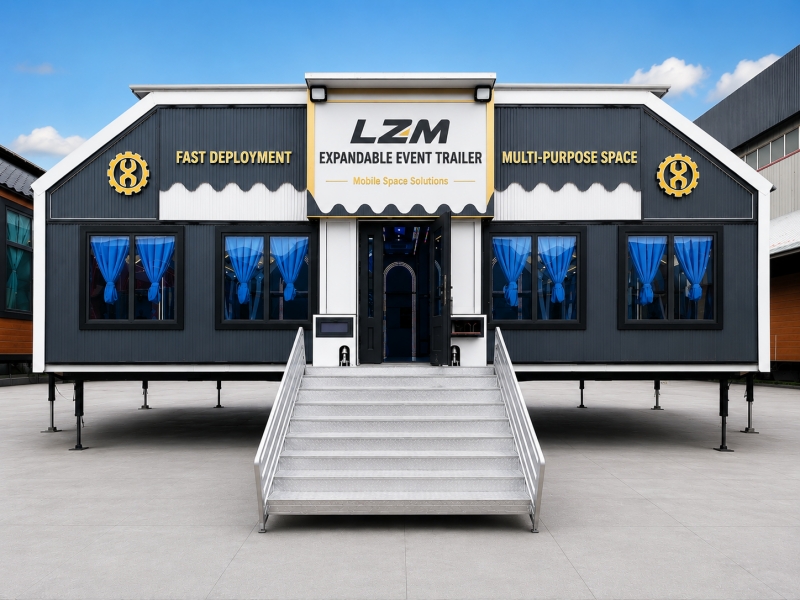
A large expandable event trailer can travel in a relatively compact transport configuration and then create a much wider indoor venue after arriving at the site.
The transformation looks simple from the outside:
Arrive → Level → Expand → Open the Venue
But moving large structural sections safely requires much more than attaching a few hydraulic cylinders to the trailer.
The hydraulic system must work together with:
Main steel structure
Expandable side sections
Support legs
Floor system
Electrical controls
Sensors or limit controls where applicable
Site leveling procedures
For wedding venue operators, event rental companies and commercial buyers, understanding this system is important because the hydraulic equipment directly affects deployment speed, operating reliability and long-term maintenance.
Large expandable structures are heavy.
Moving them manually would be slow, labor-intensive and potentially unsafe.
Hydraulic systems are commonly used because they can generate substantial controlled force through relatively compact equipment.
Depending on the trailer design, hydraulics may be used for functions such as:
Extending side sections
Retracting side sections
Operating support legs
Adjusting structural position
Assisting deployment procedures
Instead of requiring a large crew to physically move major sections, the operator can control much of the transformation through the designed hydraulic system.
It is important to understand that hydraulics are only one part of the expansion mechanism.
A complete system may involve:
Hydraulic Power
Mechanical Guidance
Structural Supports
Electrical Control
The hydraulic cylinder provides force.
The structural system determines how the expandable section moves.
Guide mechanisms help control the movement path.
Support systems carry loads after deployment.
The control system coordinates operation.
A reliable expandable venue depends on all of these elements working together.
The exact design varies by model, but a hydraulic expansion system typically includes components such as:
Hydraulic pump
Electric motor
Hydraulic oil reservoir
Cylinders
Valves
Hoses
Fittings
Pressure-control components
Control system
Some designs may also incorporate additional monitoring or safety components.
Each part has a different role.
Creates the hydraulic flow needed to operate the cylinders.
Convert hydraulic pressure into controlled linear movement.
Direct and regulate hydraulic flow.
Stores hydraulic oil.
Carry hydraulic fluid between components.
The system should be designed according to the loads and operating sequence of the actual trailer.
Deployment should follow a defined sequence rather than immediately expanding the structure after parking.
A typical process may broadly involve:
1. Position the trailer
2. Check the surrounding deployment area
3. Stabilize and level the unit
4. Confirm adequate ground support
5. Begin structural expansion
6. Deploy floor or related structural sections according to the design
7. Confirm final structural position
8. Complete interior setup and utility connection
The specific sequence should always follow the manufacturer's operating instructions for that model.
A large mobile venue cannot simply be parked on an uneven surface and treated like a permanent building.
Site slope can affect:
Expansion geometry
Floor alignment
Door operation
Structural load distribution
Guest comfort
The trailer therefore needs to be positioned and leveled appropriately before normal event use.
Hydraulic support systems can help with this process, depending on the configuration.
Support legs are extremely important in large expandable trailers.
Once the venue is deployed, the structure creates a much wider footprint than the road chassis alone.
Support systems can help:
Stabilize the structure
Transfer loads to the ground
Maintain floor level
Reduce unwanted movement
Support expanded sections
They should not be viewed as ordinary parking jacks.
They are part of the deployed structural system.
A hydraulic support leg can generate substantial force.
But the ground beneath it must be able to accept that load.
Potential installation surfaces may include:
Concrete
Asphalt
Compacted gravel
Prepared event ground
Other engineered surfaces
Soft or poorly prepared ground can create problems.
A support foot that gradually sinks changes the geometry of the entire venue.
This can lead to:
Uneven floors
Misaligned doors
Structural stress
Instability
Ground conditions should therefore be checked before deployment.
On some sites, suitable pads or other load-spreading arrangements may be used beneath support points.
The objective is to distribute the load across a larger surface area.
Whether this is necessary depends on:
Trailer weight
Support reactions
Ground bearing capacity
Surface type
Site conditions
The correct support solution should be determined according to the project and site.
The trailer requires much more space after expansion than during transportation.
Before operating the hydraulic system, staff should confirm that the expansion zone is clear of:
Vehicles
Temporary fencing
Trees
Utility poles
Event structures
Equipment
People
Overhead clearance can also matter.
The operator should think in three dimensions:
Length + Width + Height
not only the ground footprint.
A large expandable section should not move unpredictably.
The system needs to guide the structure through a defined path.
Controlled movement helps maintain:
Alignment
Structural integrity
Seal performance
Floor geometry
Final positioning
If one section moves incorrectly relative to another, it can create unnecessary stress on the structure.
This is why the hydraulic and mechanical systems must be engineered together.
Some expandable structures use multiple hydraulic actuators to move large sections.
Where more than one cylinder participates in a movement, the design needs to control the movement appropriately.
The goal is to prevent one part of the structure from advancing too far relative to another.
Depending on the engineering design, synchronization can involve:
Hydraulic control
Mechanical guidance
Electrical control
Operator procedures
The exact solution varies by trailer.
Buyers should focus on whether the complete mechanism operates reliably rather than simply counting cylinders.
A sales brochure might emphasize the number of hydraulic cylinders.
That number alone tells buyers very little.
A good system depends on:
Correct cylinder sizing
Suitable mounting
Hydraulic pressure
Structural geometry
Valve control
Hose routing
Mechanical guidance
A poorly engineered system with many cylinders can still perform badly.
A properly designed system uses the required components for the actual structural load.
Higher hydraulic pressure is not automatically better.
The system should provide sufficient force with appropriate engineering margins.
Excessive pressure can increase stress on:
Cylinders
Hoses
Fittings
Structural mounting points
Pressure settings should therefore follow the hydraulic design.
Operators should not modify pressure-control components casually in an attempt to make the trailer move “faster” or “stronger.”
Buyers often ask:
“How fast can it open?”
Fast deployment is useful.
But maximum speed should not be the only objective.
A large structure should expand in a controlled manner.
Excessively rapid movement can make:
Alignment harder
Inspection harder
Operation less controlled
The useful metric is not simply the number of minutes required.
It is:
Can trained operators deploy the venue repeatedly, safely and consistently?
Even if the hydraulic movement itself is relatively fast, complete event setup can take longer.
The operator may still need to:
Position the trailer
Prepare supports
Connect electricity
Check HVAC
Install furniture
Connect AV equipment
Prepare catering areas
Install branding
Perform safety checks
Therefore, manufacturers should distinguish between:
Hydraulic Expansion Time
and
Complete Event Setup Time.
They are not the same measurement.
Imagine two identical trailers.
Used as an empty temporary exhibition hall.
Used for a luxury wedding.
Trailer B may require additional:
Tables
Chairs
Decorative lighting
Flowers
AV
Tableware
Guest signage
The hydraulic system can open both trailers in a similar manner.
But the wedding venue requires substantially more event preparation afterward.
Buyers should not assume hydraulic opening time equals total labor time.
The hydraulic pump normally requires an energy source.
Depending on the specific project, this may be integrated into the electrical configuration.
The buyer should understand:
Required voltage
Power source
Operating procedure
Backup arrangement if applicable
This is especially important for remote sites where suitable external electricity may not be immediately available.
Deployment power should be planned before the trailer arrives.
Depending on the system design and electrical requirements, a suitable generator may potentially provide the required power where grid electricity is unavailable.
However, the generator needs to be properly matched to the load.
Buyers should not assume that any small portable generator will operate the system correctly.
The manufacturer should provide the relevant power requirement for the supplied configuration.
This is a very important buyer question.
A commercial operator should understand the emergency procedure before the first event.
Depending on the hydraulic design, backup or emergency arrangements may be available for situations such as:
Power interruption
Electrical-control failure
Hydraulic component problem
The specific method should be explained in the operation documentation for the actual system.
The key point is:
Do not wait for a failure to discover the emergency procedure.
Operators should learn it during commissioning and training.
A manual or backup method is useful.
But it should not become the routine way of operating a poorly maintained hydraulic system.
If the trailer repeatedly needs emergency operation, the underlying fault should be diagnosed and repaired.
Commercial rental equipment needs predictable operation.
Repeated improvised solutions are not an acceptable long-term maintenance strategy.
Hydraulic oil is the working fluid of the system.
Its condition can influence:
Pump performance
Valve operation
Cylinder performance
Component wear
Maintenance may involve checking:
Oil level
Oil condition
Contamination
Leakage
The correct oil specification and maintenance interval should follow the system manufacturer's recommendations.
Operators should not mix random hydraulic fluids simply because they appear similar.
A small oil leak can indicate:
Loose fitting
Damaged hose
Seal wear
Component damage
Ignoring the leak can allow the problem to become larger.
It can also create:
Dirty equipment
Slip hazards
Environmental issues
Reduced system performance
Rental operators should inspect hydraulic components regularly.
Hydraulic hoses experience:
Pressure
Movement
Temperature
Vibration
Aging
They should therefore be inspected for:
Abrasion
Cracking
Bulging
Leakage
Damaged fittings
Routing matters as well.
A hose repeatedly rubbing against a steel edge can fail long before an otherwise identical properly routed hose.
Expandable structures move.
The hydraulic lines must move with them without becoming:
Pinched
Stretched
Twisted
Abraded
Cable and hose routing is therefore an important design detail.
A trailer may look impressive from the outside, but poor hose management can create recurring maintenance problems.
Exposed hydraulic cylinder rods should be kept in suitable condition.
Damage or contamination on rod surfaces can affect seals and lead to leakage.
Operators should avoid situations where exposed rods are:
Struck by equipment
Covered in abrasive dirt
Damaged during loading
Used as attachment points
Hydraulic cylinders are precision components, not structural handles.
Some wedding and event markets are seasonal.
A trailer may remain unused for weeks or months.
Before returning it to commercial operation, the operator should inspect:
Hydraulic oil
Hoses
Fittings
Cylinders
Electrical controls
Supports
Moving structural components
A successful deployment several months ago does not guarantee that the trailer should be operated without inspection today.
Hydraulic components can be sensitive to contamination.
Dirt entering the system can affect:
Valves
Pumps
Seals
Cylinders
Maintenance work should therefore be performed cleanly.
Opening hoses or fittings in dirty outdoor conditions without proper control can introduce contamination.
Commercial operators should treat hydraulic maintenance as technical work.
Hydraulic fluid viscosity changes with temperature.
Very cold environments can affect system behavior.
A trailer operating in northern climates may therefore require different operating considerations from a trailer used only in hot regions.
The manufacturer should understand the expected temperature range during project specification.
This is another reason buyers should provide real operating conditions rather than simply saying:
“It will be used in the United States.”
The climate differs enormously between states and seasons.
Hot climates create another challenge.
Hydraulic equipment and oil may operate in environments with high ambient temperatures.
Projects intended for markets such as:
Saudi Arabia
UAE
Texas
Northern Australia
should take local operating temperatures into account.
Hydraulic, electrical and HVAC engineering all need to be designed around the actual environment.
A trailer repeatedly used near the sea may encounter:
Salt
Humidity
Corrosive atmosphere
Hydraulic components, fittings and exposed steel elements should therefore be included in the project's corrosion-protection planning.
The hydraulic system cannot be considered separately from the rest of the trailer's environmental exposure.
Hydraulic maintenance should not focus only on the cylinders that move the side sections.
Support systems may experience substantial load during every event.
Operators should inspect relevant:
Cylinder condition
Mounting points
Feet
Pins
Welded areas
Hydraulic connections
A support component is part of the deployed structural system.
Its condition matters to the complete venue.
If a hydraulic cylinder operates perfectly but its mounting structure is damaged, the system is still unsafe.
Inspection therefore needs to consider both:
Hydraulic Components
and
Structural Attachment Points.
Look for unusual:
Deformation
Loose fasteners
Cracking
Wear
Misalignment
A hydraulic problem can sometimes be the symptom of a mechanical problem elsewhere.
Operators become familiar with the normal sound and speed of their equipment.
Changes such as:
New vibration
Unusual pump noise
Jerky movement
Slower operation
Uneven movement
can indicate that inspection is required.
Continuing to operate simply because the trailer still moves may allow a minor problem to develop into a more serious failure.
If an expandable section stops moving correctly, increasing hydraulic pressure is not automatically the correct response.
The obstruction could involve:
Mechanical interference
Site leveling
Guide alignment
Foreign object
Structural issue
Applying additional force can make the situation worse.
The operator should stop and identify the cause according to the troubleshooting procedure.
One major advantage of hydraulic automation is reducing manual work.
It does not eliminate the need for trained personnel.
The operator should understand:
Deployment sequence
Site clearance
Support procedure
Control system
Emergency stop
Troubleshooting
Emergency retraction procedure
For a rental company, training should not depend on one employee being the only person who knows how the trailer works.
A repeatable checklist can reduce mistakes.
Before expansion, staff may verify:
Correct site position
Adequate clearance
Suitable ground
Trailer stabilized
Required power available
No people in moving zones
Hydraulic system visually inspected
Control system operational
After expansion, the team can confirm:
Final alignment
Support condition
Floor level
Doors
Seals
Utilities
Interior safety
Consistent procedures are particularly useful for rental companies operating at many different sites.
Commercial operators should keep maintenance records.
Useful information can include:
Inspection dates
Oil changes
Hose replacement
Cylinder repairs
Leakage repairs
Control-system issues
Support-system inspections
This makes it easier to identify recurring problems and plan preventive maintenance.
It may also help when the trailer is sold later.
A hydraulic hose may cost relatively little.
A failed event can cost much more.
Imagine a wedding venue that cannot open on the morning of the event.
The commercial consequences can involve:
Emergency repair
Refunds
Reputation damage
Customer compensation
Lost future bookings
For a commercial event operator, hydraulic maintenance should therefore be viewed as business continuity, not simply equipment servicing.
For buyers importing an expandable event trailer from China, waiting for every replacement part to arrive internationally can create unnecessary downtime.
Depending on the configuration, the manufacturer may recommend keeping selected components or consumables available locally.
The exact spare-parts package should be based on the actual hydraulic and control system.
It is usually better to plan this before shipment.
For commercial equipment, maintainability matters.
When possible, buyers should ask:
Are hydraulic fittings identifiable?
Are hoses replaceable locally?
Are seals or standard components available?
Can the local hydraulic service industry support the system?
An exotic component with no local replacement source can create unnecessary downtime.
International projects benefit from considering serviceability during design.
A beautiful interior should not make technical maintenance impossible.
Hydraulic components that require routine inspection or servicing should remain reasonably accessible.
This may include:
Pump
Reservoir
Valves
Hose connections
Cylinder mounting areas
Maintenance access should be considered during the engineering stage.
Hiding every technical component behind permanent luxury decoration can create expensive service problems later.
A hotel may deploy an expandable banquet hall and leave it open for six months.
An event rental company may:
Close Monday → Transport Tuesday → Open Wednesday → Event Thursday → Close Friday
Frequent movement increases the importance of:
Reliable hydraulics
Repeatable leveling
Fast inspections
Easy servicing
Operator training
The same physical product can therefore have different maintenance priorities depending on the business model.
Manufacturers should understand whether the trailer will expand:
Several times per year
Several times per month
Several times per week
A high-frequency rental fleet has different operational expectations from a semi-permanent project.
This information can influence component selection and maintenance planning.
The word “automatic” can create unrealistic expectations.
A hydraulic system can automate major movements.
But safe deployment still requires human supervision.
The operator needs to watch for:
Obstructions
Uneven movement
Ground settlement
Unexpected noise
Hydraulic leakage
A large mobile venue should never be treated like a household appliance that can simply be switched on and ignored.
Depending on the control configuration, remote operation can allow the operator to stand where they can better observe moving sections.
This can improve visibility during deployment.
However, remote control should not bypass safety procedures.
The operator still needs to maintain clear sight of critical movement areas and prevent unauthorized people from entering the deployment zone.
Any powered movement involving large structural components requires appropriate control of unexpected situations.
If something enters the movement zone or abnormal behavior occurs, the operator needs to be able to stop the process.
The exact control architecture depends on the design.
Buyers should ask manufacturers how normal operation and emergency stopping are handled.
Guests, event staff and curious bystanders should not stand beside moving sections while the trailer is opening.
Deployment should occur before public access.
The operator can establish a clear temporary safety perimeter around the unit.
Once the structure is fully deployed, inspected and ready, the site can transition from:
Equipment Setup Area
to
Guest Venue.
The same principle applies when closing the venue.
Furniture and event equipment should be removed or secured according to the operating procedure.
The structure should be checked.
Guests and unauthorized personnel should remain outside the moving areas.
Retraction is an equipment operation, not part of the entertainment.
An expandable trailer cannot necessarily be retracted with every piece of event furniture left exactly where it was during the event.
Operators need to understand:
What must be removed
What can remain
Where movable equipment must be positioned
How loose items are secured
A poorly organized breakdown procedure can slow the entire operation.
Luxury decoration cannot interfere with the expansion mechanism.
Items such as:
Wall panels
Curtains
Cables
Screens
Furniture
Decorative fixtures
must be designed or positioned so they do not obstruct moving sections.
An expandable venue is fundamentally different from a permanent ballroom.
Interior design needs to respect the mechanical architecture.
Hydraulic components are not the only systems crossing moving sections.
Expandable structures may also need to manage:
Electrical wiring
Lighting circuits
Control cables
Communication cables
These systems must move without being damaged.
Cable management should therefore be coordinated with the structural movement path.
Depending on the HVAC configuration, climate-control components may interact with moving parts of the venue.
The system design needs to consider:
Equipment location
Ducting
Lines
Electrical connections
Expansion movement
The objective is to avoid creating vulnerable connections that are repeatedly strained every time the trailer opens.
Trailers with:
Restrooms
Bars
Kitchens
may contain plumbing.
If water lines cross expandable sections, the design needs to accommodate movement appropriately.
Again, the key lesson is that the hydraulic system is part of a larger integrated mobile-building system.
When deployed, the customer expects a usable event floor.
They do not want a venue where different sections feel noticeably misaligned.
The mechanical expansion and support system therefore influences:
Floor continuity
Floor level
Furniture stability
Guest comfort
Good hydraulic operation is partly invisible.
Guests should experience a stable venue rather than thinking about the mechanism underneath it.
This is especially important for:
Banquet tables
Dancing
High heels
Serving staff
Decorative installations
Small inconsistencies that might be acceptable in an industrial temporary structure can become more noticeable in a luxury wedding venue.
Leveling and support procedures therefore directly influence the guest experience.
A large LED wall or AV installation can be sensitive to movement and alignment.
A properly supported deployed venue provides a better platform for:
Screens
AV
Lighting
Stage equipment where specified
Equipment should still follow the approved structural load requirements.
The hydraulic system does not eliminate the need for proper load planning.
Operators should never attempt to “fight” unsuitable weather simply by applying more hydraulic pressure or support force.
Wind limits and weather operating conditions belong to the structural engineering and operating requirements of the venue.
If environmental conditions exceed permitted operating limits, safety procedures must take precedence over keeping the event open.
A support leg transfers load to the ground.
That does not automatically mean it functions as a wind anchor.
Stability, anchoring and support are different engineering concepts.
The project's structural design should define what is required for the intended operating conditions.
Buyers should not improvise anchoring methods at the site.
There is no responsible universal number of years or cycles that applies to every expandable trailer.
Service life depends on factors including:
Component quality
Engineering design
Operating frequency
Maintenance
Climate
Contamination
Operator behavior
A system that is inspected and maintained properly can perform very differently from one operated without routine care.
Commercial buyers should therefore ask about maintenance requirements, not only theoretical lifespan.
Saving money on critical components can increase future costs through:
Downtime
Leakage
Replacement
Labor
Lost bookings
For an event rental company, reliability has direct financial value.
One cancelled premium wedding can cost more than the difference between two component specifications.
Purchase decisions should therefore consider lifecycle cost.
Before purchasing internationally, ask:
Can a normal hydraulic service company in my country work on this system?
In many markets, local hydraulic specialists can manufacture hoses and service standard components.
That is valuable.
A commercial trailer should not become unusable because every minor hydraulic repair requires an engineer to fly internationally.
The buyer should receive appropriate operating and technical information for the supplied system.
Useful documentation may include:
Operating sequence
Hydraulic schematic where appropriate
Component information
Maintenance guidance
Troubleshooting information
Emergency operation procedure
Documentation becomes particularly important when the original trained operator leaves the company.
The knowledge should stay with the business.
The first paid wedding or corporate event should not be the team's first attempt at operating the trailer.
Before commercial use, staff should practice:
Deploy → Inspect → Operate → Retract
multiple times under controlled conditions.
This allows the team to understand:
Normal sounds
Normal movement
Setup sequence
Timing
Common mistakes
Practice reduces pressure during real events.
A hydraulic system can reduce deployment labor.
But rental companies should still calculate the total staff required for:
Transport
Positioning
Expansion
Utilities
Interior preparation
Breakdown
The economic advantage comes from creating a repeatable process.
Automation alone does not automatically eliminate every setup cost.
For a rental company, the expansion system has a direct relationship with utilization.
Consider two assets.
Requires complicated manual assembly and a large crew.
Uses an integrated hydraulic expansion system and a repeatable deployment procedure.
If Asset B can be repositioned between events more efficiently, it may support:
Faster turnaround
Lower setup labor
More bookings
More predictable operations
The hydraulic system is therefore not just an engineering feature.
It can influence the business model.
For a resort or school that moves the venue only occasionally, deployment speed may be less important.
Their priorities may instead be:
Long-term stability
Simple operation
Maintenance access
Reliability after long periods of deployment
The best configuration depends on how the asset will actually be used.
Before ordering, commercial buyers should clarify:
Which movements are hydraulic?
How is the trailer leveled?
How are expandable sections supported?
What power supply is required?
What is the normal operating sequence?
What happens during power failure?
What maintenance is required?
Which components are consumable or replaceable?
Can hydraulic hoses be serviced locally?
What spare parts are recommended?
Is technical documentation provided?
What operator training is available?
These questions provide much more useful information than simply asking:
“Is it fully hydraulic?”
For international buyers, a real deployment video can help explain the mechanism more clearly than photographs.
A useful video should show the actual sequence:
Closed Trailer
↓
Positioning / Supports
↓
Expansion
↓
Fully Deployed Venue
Where possible, buyers should pay attention to:
Movement consistency
Support arrangement
Floor alignment
Operator procedure
Marketing footage of only the finished interior does not demonstrate how the mechanical system operates.
A completed trailer should be tested before delivery.
Expansion and retraction allow the manufacturer to check:
Hydraulic operation
Structural movement
Controls
Supports
Alignment
Abnormal leakage or noise
International shipping makes post-delivery corrections more difficult.
Testing at the factory therefore has significant value.
Transportation itself can expose the trailer to:
Vibration
Handling
Long transit
Environmental conditions
After arrival, the buyer should inspect and commission the trailer before the first commercial event.
This includes operating the expansion system in a controlled environment.
The first deployment after international shipping should not happen on the morning of a major wedding.
The luxury interior is what guests see.
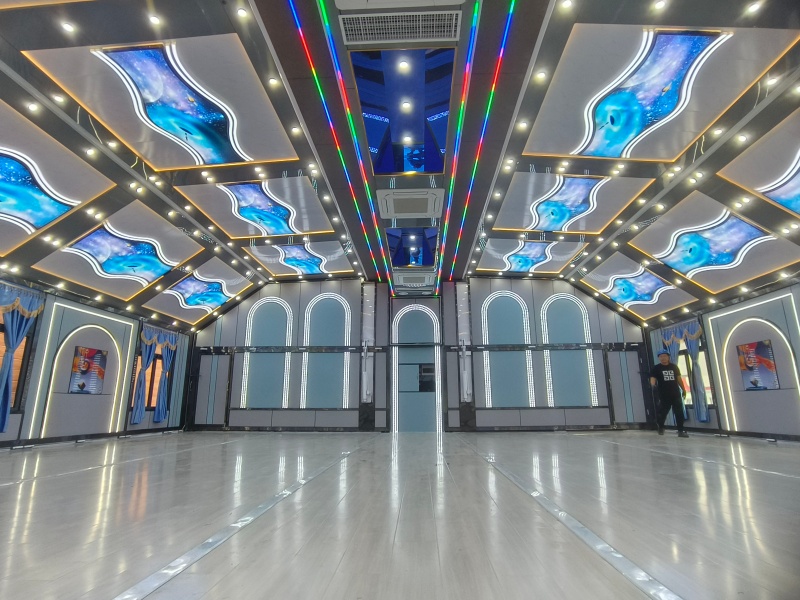
The hydraulic and structural systems are what allow that interior to exist in two very different forms:
A compact transportable structure.
A large indoor commercial venue.
That transformation is one of the defining technical characteristics of an expandable event trailer.
For buyers, the important question is therefore not simply:
Does it use hydraulics?
It is:
Is the complete expansion system engineered for reliable, repeated commercial operation?
A successful system needs to coordinate:
Hydraulics + Structure + Supports + Controls + Site Conditions + Maintenance + Operator Procedure
When those elements work together, an expandable event trailer can move between transport mode and venue mode efficiently while supporting repeated use for weddings, corporate events, hospitality and event rental operations.
LZM manufactures hydraulic expandable event trailers in multiple configurations and can develop the expansion system, leveling/support arrangement, electrical controls and interior layout according to the project size and intended application.
Explore hydraulic expandable event trailer configurations and discuss the deployment requirements for your project:
Hydraulic Expandable Event Trailer Systems & Configurations