Welcome: Laizhou Machinery Group



“How much does the trailer weigh?”
It sounds like a simple specification question.
For a large expandable event trailer, however, one number is rarely enough.
A buyer may need to understand:
Empty weight
Operating weight
Maximum permitted weight
Axle loads
Kingpin or coupling load
Weight distribution
Chassis capacity
The final answer can also change considerably depending on what is installed inside the trailer.
A basic expandable structure and a fully equipped luxury banquet venue may have the same overall dimensions but very different weights.
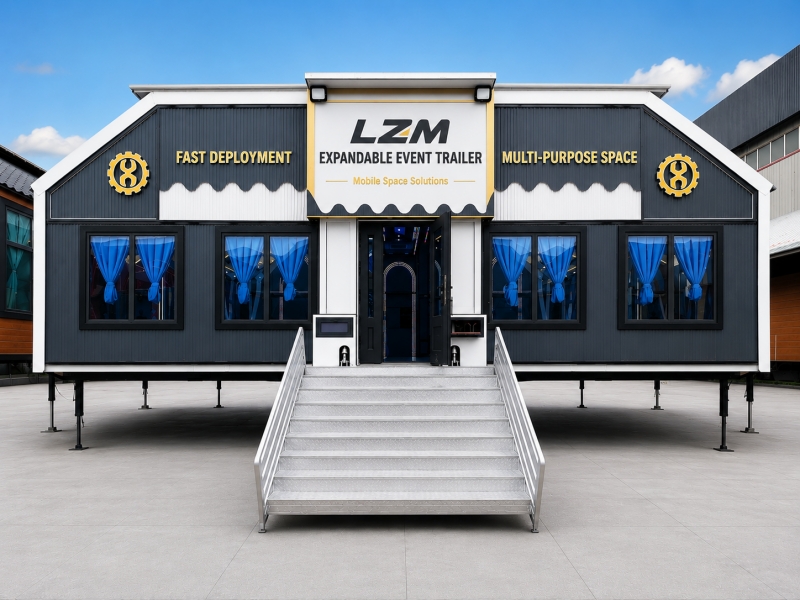
For this reason, international buyers should not evaluate an expandable event trailer by asking only:
What is the total weight?
A better question is:
What are the final weight, load distribution and chassis requirements for my exact configuration?
Weight affects much more than ocean freight.
It can influence:
Chassis selection
Number of axles
Suspension
Braking system
Tires
Coupling system
Road transportation
Local permits
Bridge restrictions
Towing equipment
Site access
It may also influence whether a proposed configuration can be legally operated on public roads in the destination market.
For a commercial mobile venue, weight is therefore a fundamental engineering parameter.
Buyers frequently ask for the trailer's empty weight.
This is useful, but it does not necessarily represent the actual operating condition.
The empty trailer may later contain:
Furniture
LED displays
AV equipment
Refrigeration
Kitchen equipment
Water
Generator
Batteries
Decorations
Event supplies
The transported operating weight can therefore be significantly higher.
A chassis selected only according to the bare structure may not provide sufficient capacity after the trailer is fully equipped.
Terminology varies between markets, but in general, empty or unladen weight refers to the trailer before some or all operational payload is added.
The exact definition should be confirmed in the manufacturer's documentation.
For example, buyers need to know whether the quoted figure includes:
HVAC
Hydraulic equipment
Permanent electrical system
Fixed furniture
Water tanks
Generator
LED screens
Two manufacturers can quote an “empty weight” using different assumptions.
Therefore, compare the definition behind the number, not just the number itself.
For road operation, the maximum or actual gross weight becomes extremely important.
This represents the total weight of the trailer under the relevant loaded condition.
It may include:
Structure
Chassis
Permanent Equipment
Furniture
Operating Supplies
Payload
If the trailer carries water or other materials during transport, these loads must also be considered.
The complete transport configuration should stay within the appropriate chassis and regulatory limits.
Expandable event trailer buyers sometimes see a floor-load specification and assume it relates directly to transport weight.
They are different concepts.
Indicates how much load the deployed floor structure can support under the specified design conditions.
Indicates the weight of the complete transportable asset.
A floor may support substantial distributed guest and furniture loads while the trailer itself still needs to comply with road transportation weight requirements.
Both values matter, but for different reasons.
An expandable event trailer is not simply a thin-walled cargo box.
The structure needs to support:
Road transportation
Expansion and retraction
Large floor sections
Guests
Furniture
Interior finishes
HVAC
Lighting
Equipment
Major structural components can include:
Main steel frame
Expandable side sections
Floor structure
Roof structure
Hydraulic components
Support systems
Chassis
Larger event venues naturally require more structural material.
But size is not the only reason for weight.
Consider two trailers with identical external dimensions.
Designed as a basic exhibition or open event space.
Designed as a luxury wedding venue with:
Decorative ceiling
Premium flooring
Large LED wall
Multiple HVAC units
Refrigeration
Restroom
Water system
Trailer B may create a substantially different final weight.
This is why weight should be recalculated after major customization decisions.
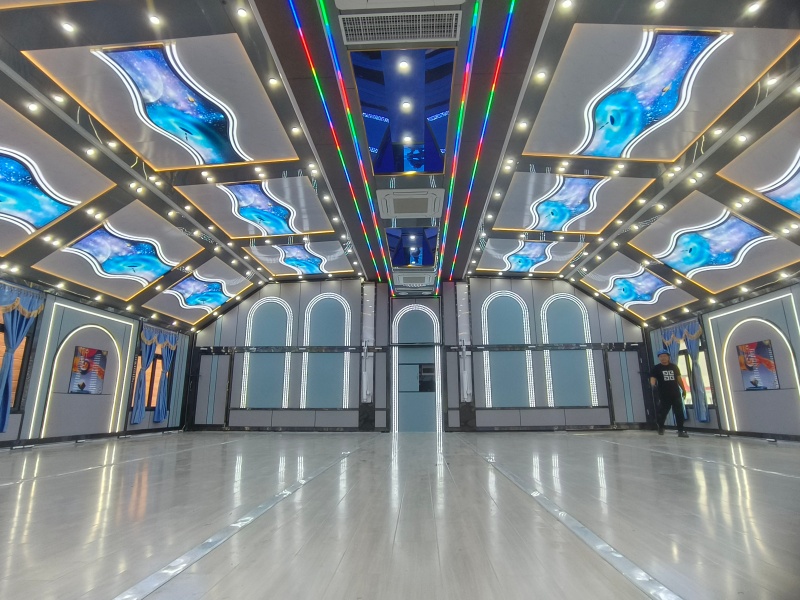
Large commercial HVAC equipment contributes to trailer weight.
The complete HVAC package may involve:
Indoor units
Outdoor units
Ducting
Refrigerant lines
Electrical equipment
Mounting structures
A trailer designed for hot climates may require a different HVAC configuration from a similar venue operating in a mild climate.
That can affect both:
Electrical Load
and
Structural Weight.
Large LED installations are increasingly common in:
Weddings
Corporate events
Sports hospitality
Brand activation
A large display is not weightless.
Its installation may include:
LED modules
Supporting structure
Controllers
Cabling
Mounting frame
If several large displays are added after the original trailer engineering is complete, the change may affect both total weight and local structural loading.
LED requirements should therefore be discussed during design.
Integrated sanitary facilities introduce additional systems.
These can include:
Toilet fixtures
Partitions
Plumbing
Pumps
Fresh-water tank
Wastewater tank
The largest change may occur when the tanks contain water.
Water is heavy.
A trailer with empty tanks and the same trailer with full tanks do not have the same transport weight.
This raises an important operational question:
Will water normally be transported inside the trailer, or filled after arrival at the site?
The answer can materially affect transport planning.
Buyers sometimes focus on the physical size of a water tank without considering the weight of the water itself.
One liter of water weighs approximately one kilogram.
So, for example, several hundred liters of stored water can add several hundred kilograms to the system.
For large tanks, the impact becomes significant.
Where practical, mobile operators may prefer to travel with tanks empty or partially filled and obtain water at the destination.
The appropriate operating procedure depends on the project.
Some trailers need independent power.
A generator may therefore be installed onboard or carried separately.
A generator can create a relatively concentrated load rather than evenly distributed weight.
That matters because structural engineering is concerned not only with:
How much weight?
but also:
Where is the weight located?
Heavy equipment should be positioned with the overall load distribution in mind.
Large battery systems can also be heavy.
If a buyer requests:
Solar
Battery backup
Energy storage
the battery capacity should be defined early.
Adding a large battery bank late in the project can alter:
Total weight
Center of gravity
Chassis load
Equipment layout
Energy-storage design is therefore connected to mechanical engineering.
Imagine a trailer whose total weight is within the chassis limit.
That does not automatically mean the design is correct.
Too much weight could still be concentrated:
At the front
At the rear
On one axle group
On one side
This can create problems even when the overall gross weight looks acceptable.
Proper weight distribution is therefore essential.
A multi-axle trailer divides its load across the axle system.
But the weight is rarely distributed perfectly equally by accident.
The engineering design needs to consider:
Axle locations
Main structure
Equipment positions
Coupling position
Center of gravity
A heavy generator mounted at one end of the trailer can change the axle loads.
So can large water tanks or fixed kitchen equipment.
A customer may see another trailer with three axles and ask:
“Can ours also use three axles?”
Maybe.
But axle selection should not be copied visually from another project.
It depends on factors such as:
Gross weight
Axle rating
Local regulations
Chassis design
Weight distribution
Suspension system
A larger or more heavily equipped trailer may require a different chassis solution.
Road regulations differ between countries.
A chassis arrangement suitable for one market may not automatically satisfy another.
Relevant requirements may relate to:
Permitted gross weight
Axle loads
Axle spacing
Trailer dimensions
Braking
Lighting
Suspension
Coupling
Therefore, international buyers should provide the destination market before chassis design is finalized.
“Export specification” is not one universal specification.
For U.S. projects, buyers may need to investigate applicable federal and state requirements involving:
Trailer dimensions
Gross vehicle weight
Axle loads
Braking
Lighting
Registration
Permits
The exact requirements depend on the final configuration and operating route.
A trailer that operates only locally may face different practical transport conditions from one traveling across multiple states.
The buyer should therefore consider how the asset will actually be used.
Australian buyers commonly ask for information such as:
Tare weight
ATM / aggregate trailer mass
GTM
Axle configuration
Tow-ball or coupling load
GVM-related information where applicable
The terminology and regulatory structure may differ from other markets.
This is another reason manufacturers and buyers need to agree on exactly which weight figures are being discussed.
Do not assume that a generic “gross weight” specification answers every Australian compliance question.
European road-vehicle compliance can involve demanding type-approval and technical requirements.
For some projects, buyers may therefore consider importing only the expandable superstructure and using a locally compliant chassis.
In that case, weight information becomes even more important.
The local chassis engineer may need:
Superstructure weight
Center of gravity
Mounting points
Equipment positions
Load distribution
A vague statement such as “approximately 15 tons” may not be sufficient for engineering.
When the chassis is manufactured locally, the buyer should request more than total superstructure weight.
Useful information may include:
Estimated empty superstructure weight
Final equipment weight
Weight distribution
Center-of-gravity information where available
Mounting positions
Structural interface
Recommended chassis parameters
The local chassis designer then has a clearer basis for engineering.
This coordination should occur before either side completes manufacturing.
Expandable structures operate in two fundamentally different conditions:
The side sections are closed and the trailer load is carried by the chassis.
The structure expands and additional support systems transfer loads to the ground.
These two conditions need different engineering analysis.
The chassis handles road transportation.
The deployed support system helps stabilize and support the expanded venue.
Buyers should not assume the axle system alone supports the complete venue in the same way during an event.
Once deployed, support legs or other structural support systems transfer loads to the site.
The ground therefore needs adequate bearing capacity.
A soft surface may require appropriate preparation or load-spreading solutions.
Potential sites include:
Asphalt
Concrete
Compacted ground
Gravel
Temporary event fields
The operator should verify site suitability before deployment.
A stable trailer depends on both the machine and the ground beneath it.
A large trailer has a three-dimensional center of gravity.
Its position affects stability and handling.
Heavy equipment mounted high in the structure can influence the center of gravity.
This is another reason why equipment should not be placed entirely according to interior appearance.
Engineering needs to consider:
Vertical position
Front-to-rear position
Side-to-side balance
Interior designers and structural engineers therefore need to work together.
Luxury does not mean installing the heaviest possible material.
A commercial mobile venue must balance:
Appearance
with
Transportation Efficiency.
For example, designers can select materials that provide a premium visual result without unnecessary structural mass.
This is particularly important in mobile architecture.
A material may be perfectly suitable for a permanent hotel ballroom but inefficient inside a frequently transported trailer.
For a permanent building, a decorative material is installed once and remains there.
For a mobile venue, that weight travels repeatedly.
A rental company moving the trailer throughout the year effectively transports every unnecessary kilogram on every booking.
More weight can influence:
Fuel
Towing requirements
Transportation complexity
Component wear
This does not mean the trailer should be lightweight at the expense of strength.
It means weight should be engineered deliberately.
Rental operators need to decide what travels inside the trailer.
Possible strategies include:
Convenient for deployment, but increases transported weight.
Requires an additional vehicle but can simplify internal trailer loading.
Useful for longer-distance projects but reduces equipment consistency.
The best strategy depends on the rental model.
Guests are present when the venue is deployed.
They are normally not traveling inside the event trailer.
Therefore, a venue designed for a large number of guests does not need to carry all of that live occupancy load while driving down the road.
Again, there are two structural scenarios:
Road Load Condition
and
Event Occupancy Condition.
Both need to be engineered correctly, but they are different.
Once deployed, the floor must support:
Guests
Tables
Chairs
Equipment
Catering
Dance areas
Commercial venue buyers should therefore confirm the intended floor design load separately from the road weight.
Heavy specialist equipment may require additional engineering consideration.
If a customer intends to place unusually concentrated loads inside the venue, this should be disclosed before production.
Commercial kitchens can contain heavy:
Refrigerators
Ovens
Counters
Water systems
Cooking equipment
These items may be concentrated in one area.
A full kitchen therefore affects more than total weight.
It can influence:
Local floor loading
Weight distribution
Electrical system
HVAC
Plumbing
This is why food preparation requirements should be defined at the beginning of the project.
It is tempting to assume:
15m trailer = X weight
17m trailer = Y weight
21m trailer = Z weight
Length certainly affects structure.
But two 15m projects can still differ considerably.
One might be:
Open Corporate Event Space
while another is:
Luxury Wedding Hall + Restrooms + Generator + Large Screens.
The final specification determines the final weight.
Published model weight should therefore be treated as a reference until the project configuration is fixed.
During early sales discussions, manufacturers may provide preliminary weight data.
That is normal.
At this stage:
Interior is not finalized
HVAC may change
Equipment is undecided
Chassis may not be selected
Buyers should distinguish between:
Used for planning.
and
Based on the manufactured configuration.
The two should not be treated as identical.
For completed projects, actual weighing can provide important transport information.
Depending on the manufacturing and logistics process, useful measurements can include:
Total weight
Axle-group weight
Individual axle loads where required
These figures help confirm whether the actual finished trailer matches the design assumptions.
This is particularly valuable for highly customized projects.
The factory may deliver a compliant configuration.
The owner can later change it.
For example, adding:
Larger generator
New LED wall
Additional batteries
Water tanks
Heavy furniture
can alter the weight and distribution.
Operators should therefore treat major modifications as engineering changes, not just interior decoration.
Designing a trailer with zero remaining payload flexibility can create operational problems.
Rental companies often discover new requirements later.
They may want to carry:
Additional furniture
AV equipment
Event supplies
Where practical, maintaining reasonable payload reserve can make the asset easier to operate.
How much reserve is appropriate depends on the chassis and market requirements.
Adding another axle may increase available capacity in some designs.
But it can also affect:
Chassis geometry
Turning
Tire scrub
Suspension
Cost
Local regulations
Axle spacing
Axle configuration should therefore be engineered as a complete chassis system.
It is not simply a question of adding wheels until the trailer can carry the weight.
Part of the trailer's load may be transferred through the coupling arrangement depending on the chassis design.
This affects the towing vehicle and connection system.
The towing unit needs to be compatible with the actual trailer configuration.
Buyers should confirm:
Coupling type
Permitted load
Towing vehicle requirements
Local regulations
before putting the trailer into road service.
A large commercial expandable venue is not a conventional recreational trailer.
It may require specialized towing equipment.
The appropriate tractor or towing vehicle depends on:
Trailer gross weight
Coupling system
Axle configuration
Road regulations
Operating terrain
Rental operators should include towing requirements in their business plan.
Purchasing the trailer without planning how it will be moved creates an avoidable operational problem.
Consider two buyers.
Deploys the trailer once and leaves it on site for several years.
Moves the trailer every week.
The rental operator is much more sensitive to:
Transport weight
Towing cost
Tires
Brakes
Axle service
Fuel
Road permits
Both buyers need structurally safe designs.
But their commercial priorities are different.
If the venue will rarely travel, a buyer may prioritize:
Larger floor area
More elaborate interior
Additional equipment
over frequent transport efficiency.
However, if the structure remains legally classified and transported as a trailer, road limits still matter whenever it does move.
“Semi-permanent” does not automatically remove transportation requirements.
International buyers should also distinguish:
Shipping Weight
from
Normal Road Operating Weight.
For ocean shipment, some components may be:
Removed
Packed separately
Shipped inside another container
After arrival, those items may be installed locally.
Therefore, the weight used by the ocean freight company may not always equal the completed operating road weight.
The documentation should make the distinction clear.
A trailer can create logistics challenges through both:
Size
and
Weight.
An oversized but relatively light trailer can still require special transport arrangements.
A compact but extremely heavy unit can create another type of restriction.
International project planning therefore needs:
Length + Width + Height + Weight
rather than focusing on one parameter.
For oversized cargo, freight is influenced by multiple factors.
Weight can affect:
Inland transport
Port handling
Crane selection
RoRo acceptance
Specialized cargo arrangements
However, shipping cost is not determined by weight alone.
Dimensions can be equally or more important.
A proper logistics quotation therefore requires the complete transport specification.
The final event site can create additional constraints.
A rural wedding property may be accessible only through:
Small bridges
Narrow roads
Private driveways
The trailer may be legal on the main highway but unsuitable for the final access route.
Operators should check:
Bridge load limits
Road condition
Turning areas
Ground strength
before accepting a booking.
For repeated commercial use, the operator should maintain a clear technical transport sheet.
It can include:
Closed length
Closed width
Closed height
Empty weight
Normal operating weight
Maximum authorized weight
Axle configuration
Axle loads
Coupling information
Required towing vehicle
This information can be used by:
Drivers
Transport contractors
Event planners
Site managers
It reduces repeated uncertainty before each booking.
A good event-site survey should not ask only:
“Is there enough room?”
It should also ask:
Is the access road suitable?
Are there bridge restrictions?
Can the ground support the vehicle?
Can support legs be deployed safely?
Are underground services present?
This becomes especially important for large mobile venues.
Before requesting the final chassis design, tell the manufacturer about major equipment such as:
Generator
Battery system
Water tanks
Restrooms
Kitchen
Large LED screens
Heavy furniture
AV equipment
Do not wait until manufacturing is almost finished.
These items affect the engineering.
For a serious commercial project, request the relevant data for the actual configuration.
Depending on the project stage, this may include:
Estimated empty weight
Estimated completed weight
Maximum design / permitted weight where applicable
Axle configuration
Axle ratings
Weight distribution
Coupling load
Payload assumptions
Major equipment weights
Chassis capacity
For superstructure-only projects, additional engineering information may be required for the local chassis supplier.
This one question prevents a lot of confusion:
What equipment is included in this quoted weight?
For example:
Does it include HVAC?
Does it include furniture?
Does it include the generator?
Are water tanks empty?
Is the LED screen installed?
Without this context, comparing weight figures between two quotations can be meaningless.
The correct engineering sequence is:
Application
↓
Trailer Size
↓
Interior Layout
↓
Major Equipment
↓
HVAC / Electrical / Water Systems
↓
Weight Calculation
↓
Weight Distribution
↓
Chassis / Axle Confirmation
This is much more reliable than selecting a chassis first and then continuing to add equipment without recalculating the load.
This is one of the most important distinctions in expandable event trailer engineering.
When deployed, the product behaves partly like a venue:
Large interior floor
Guests
HVAC
Lighting
Furniture
When traveling, it behaves like a vehicle:
Axles
Brakes
Coupling
Weight
Road dimensions
A successful design has to satisfy both conditions.
Focusing only on the event space can create transportation problems.
Focusing only on the trailer can create a poor venue.
Buyers naturally want simple specifications.
But for a highly customized expandable event trailer, an exact final weight should ultimately be the result of the final design.
Length alone cannot provide the full answer.
Neither can a photograph of a previous project.
The manufacturer needs to know:
What are we actually building?
Only then can the structure, equipment, weight distribution and chassis be coordinated properly.
LZM manufactures expandable event trailers for weddings, banquets, corporate hospitality, brand activation and commercial event rental, with project-specific structural, chassis and equipment configurations according to the intended destination and application.
Review expandable event trailer models and discuss the weight, chassis and transport requirements for your project:
Expandable Event Trailer Specifications & Chassis Options