Welcome: Laizhou Machinery Group



A conventional public library depends on one basic assumption:
Readers can reach the building.
That works well in communities with established public infrastructure. But building another permanent library for every neighborhood, temporary community program, or underserved area may require substantial land, construction investment, and time.
For municipalities, nonprofit organizations, education programs, and community-service operators in Guadalajara, Mexico, an expandable event trailer could create a different model: a mobile community library with enough indoor space for books, reading, digital access, and group activities.
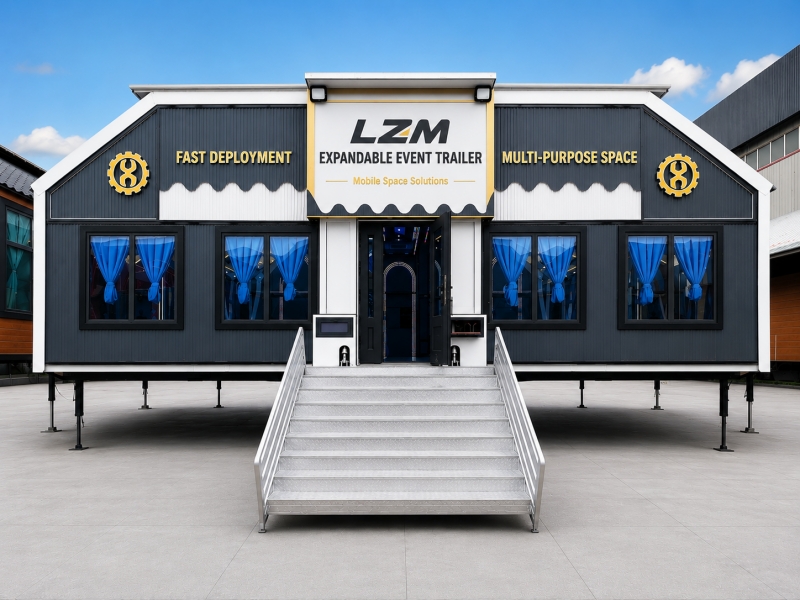
Traditional bookmobiles are useful for transporting books and providing basic lending services.
But their interior space is usually limited.
An expandable facility can approach the concept differently.
Once deployed, the trailer could provide space for:
Bookshelves
Individual reading
Children's reading areas
Study tables
Digital resources
Library staff
Small group activities
Community reading programs
Instead of functioning mainly as book transportation, the facility becomes a temporary indoor library itself.
That difference can significantly expand the types of programs the operator can provide.
Mobility does not necessarily mean moving every day.
A community library could follow a scheduled deployment model.
For example, the facility might remain in one neighborhood for several days or weeks before relocating to another approved location.
This gives residents time to use it repeatedly rather than treating the facility as a one-day event.
A possible operating schedule might include:
Community A → Community B → School District → Public Festival → Community C
The appropriate schedule would depend on local demand, transportation logistics, and the organization operating the service.
A mobile library presents a practical challenge that a permanent library does not:
What happens to the books when the trailer moves?
Bookshelves cannot simply be designed as conventional residential furniture.
The operator and manufacturer need to consider:
Shelf depth
Shelf height
Book retention
Structural fixing
Weight distribution
Storage during transportation
Access after expansion
Some materials may need to be secured before relocation.
If the library carries a large collection, the total weight of books should also be considered during project planning.
A community library may serve very different age groups.
Adults may want quiet reading or computer access, while children's programs may involve storytelling, group reading, drawing, and educational activities.
The interior could therefore include a dedicated children's area with:
Lower bookshelves
Child-sized furniture
Open floor space
Storytelling area
Display screen
Educational materials
Separating children's activities from quiet reading areas can make the same facility more useful throughout the day.
Flexible furniture can allow the area to change between programs.
Modern libraries are no longer defined only by printed books.
Some users may visit primarily because they need access to digital information.
A mobile community library could potentially provide:
Computers
Tablets
Wi-Fi
Charging points
Digital books
Online educational resources
Printing or scanning equipment
Large presentation screen
For communities with limited home internet access, this function may be particularly valuable.
Electrical capacity, connectivity, desk positions, and cable routing should therefore be considered during the initial design.
A public library often serves as more than a place to borrow books.
The expandable space could also support scheduled activities such as:
Storytelling
Reading clubs
Author presentations
Homework sessions
Digital literacy programs
Language activities
Community workshops
Educational presentations
Movable tables and chairs allow the operator to change the layout according to the day's program.
During normal hours, the space can operate as a reading room.
For a scheduled activity, part of the interior can become a small presentation or group-learning area.
An expandable community library does not need concert-level acoustic equipment, but noise still matters.
Air-conditioning equipment, conversations, children's activities, exterior traffic, and digital presentations can affect the reading environment.
Depending on the project, buyers may consider:
Insulated wall construction
Interior acoustic materials
Separate activity zones
Equipment placement
Door positioning
The goal is not complete silence, but an indoor environment appropriate for reading and concentration.
A mobile library may operate for many hours each day.
Visitors could remain inside much longer than they would at a short promotional event.
HVAC and ventilation should therefore be evaluated according to:
Trailer dimensions
Maximum occupancy
Number of computers
Outdoor temperature
Operating hours
Door-opening frequency
Local climate conditions
Suitable lighting is equally important.
Reading areas require comfortable illumination, while computer zones may need a different lighting arrangement to reduce screen glare.
A public community facility may serve children, older adults, wheelchair users, and people with different mobility needs.
Project planning should therefore consider:
Entrance access
Ramp or lifting arrangements where required
Door width
Interior aisles
Table spacing
Accessible circulation
Emergency exits
Local accessibility requirements should be reviewed before the final configuration is approved.
Accessibility is much easier to integrate during the design stage than to correct after production.
The concept is not limited to residential neighborhoods.
Depending on local permissions and the operating organization, the facility could potentially be deployed at:
Schools
Community centers
Public squares
Housing developments
Rural communities
Festivals
Corporate community programs
Temporary education projects
A municipality could use the facility as part of its public-library network.
A nonprofit organization might focus on underserved communities.
A company could potentially sponsor the facility as part of an education or community-development program.
A mobile library is also highly visible.
Exterior graphics could communicate:
Library name
Reading campaign
Sponsor information
Community program
Operating schedule
Educational messages
This can make the facility recognizable when it moves between locations.
For sponsored programs, exterior branding can also give supporting organizations visible participation without interfering with the library's interior function.
Libraries accumulate materials quickly.
In addition to books, the facility may need to carry:
Children's materials
Stationery
Tablets
Computers
Educational equipment
Folding furniture
Cleaning supplies
Program materials
Storage should therefore be planned deliberately.
If every available wall is filled with bookshelves and every square meter with seating, staff may have nowhere to store the equipment required to operate the library.
A practical floor plan needs to balance public capacity with operational space.
Before selecting the trailer size and interior configuration, the organization should provide information such as:
Expected number of visitors
Approximate number of books
Bookshelf requirements
Children's area requirements
Number of reading seats
Number of computers
Internet requirements
Presentation equipment
Staff workspace
Storage requirements
HVAC requirements
Accessibility requirements
Expected relocation frequency
Transportation, electrical systems, accessibility, fire safety, public occupancy, site use, and other applicable requirements should be evaluated according to Mexican and local project standards.
Permanent libraries remain essential public infrastructure.
But permanent construction is not the only way to increase access to reading, books, digital resources, and community education.
An expandable event trailer can provide a larger mobile indoor environment for bookshelves, reading tables, children's programs, digital access, and community activities, while allowing the same facility to serve different locations over time.
For municipalities, nonprofit organizations, education programs, and community-service operators in Guadalajara and other markets, this creates another way to take library services closer to the people they are intended to serve.
LZM develops expandable event trailers according to interior layout, capacity, electrical systems, HVAC, accessibility requirements, storage needs, and individual community applications.
Explore the expandable platform for mobile libraries and community reading projects:
Mobile Community Library & Reading Space