Welcome: Laizhou Machinery Group



A business needs another 200 square meters of usable space.
The requirement may be for a wedding venue, hospitality project, training facility, commercial event or specialized mobile operation.
The first instinct is often to construct something.
But permanent construction is not the only option — and neither is a conventional temporary structure.
An expandable event trailer introduces a third approach: a large enclosed space that can be transported, expanded at the destination and potentially moved again when the project changes.
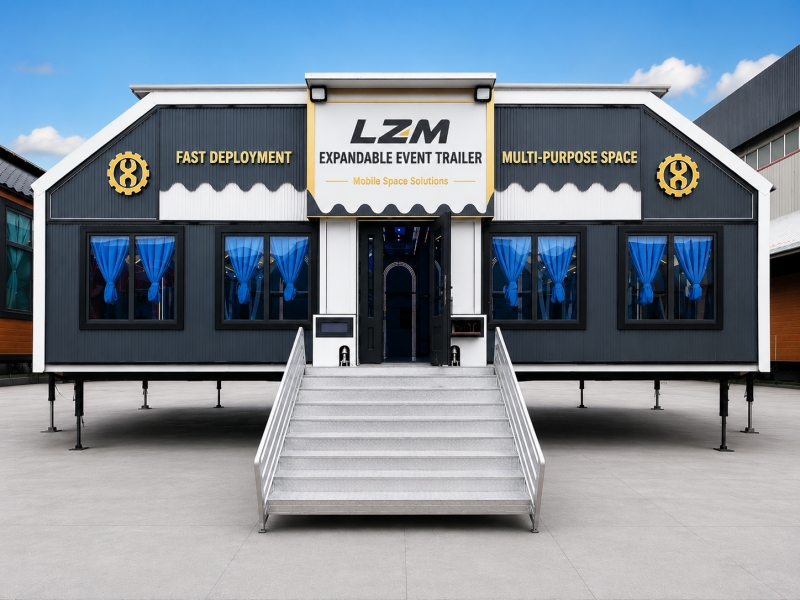
So which option makes more sense?
The answer depends less on the appearance of the structure and more on how the customer intends to use it.
This is probably the biggest dividing line.
If a company needs a facility at one location for many years, relocation may have little value.
A conventional building or another fixed solution could therefore be appropriate.
But consider a business that operates across:
Multiple event locations
Seasonal destinations
Different customer sites
Changing commercial projects
Temporary operating areas
In that situation, mobility becomes part of the investment decision.
An expandable event trailer is designed around that requirement.
The words “temporary” and “mobile” are sometimes treated as if they mean the same thing.
They do not.
A temporary structure can be installed for a limited period, but moving it may involve:
Dismantling
Packing components
Transportation
Reassembly
Interior reinstallation
An expandable trailer follows a different concept.
The primary structure remains part of the transportable unit.
After arriving at the operating location, the expandable sections are deployed to create additional usable space.
When relocation is required, the structure can be returned to transport configuration.
That difference becomes increasingly important when relocation happens repeatedly.
The cheapest initial solution is not automatically the lowest-cost solution over several years.
Imagine two businesses.
Needs a temporary facility for one project lasting three years.
The structure will probably never move.
Operates events at six locations every year.
The facility needs to follow the business.
Even if both companies require similar floor area, they have very different investment requirements.
Business B should consider:
Repeated installation
Dismantling
Transportation
Storage
Interior rebuilding
Labor
A mobile expandable facility may reduce some of these repeated processes because mobility is built into the product concept.
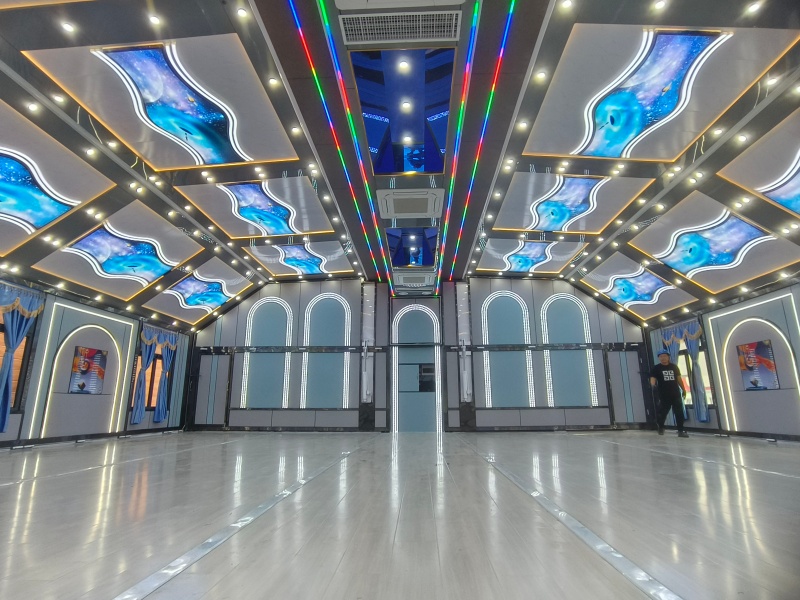
A conventional trailer is limited by road transport dimensions.
That can make the interior too narrow for applications involving large groups of people.
Expandable technology addresses this limitation.
During transportation, the unit remains in its transport configuration.
At the destination, the side sections expand to create a substantially wider interior.
This allows layouts that would be difficult inside a standard narrow trailer.
Possible arrangements include:
Banquet seating
Presentation areas
VIP lounges
Training layouts
Customer reception
Commercial activities
For projects requiring very large areas, multiple units can also be considered.
A temporary building usually arrives as components.
An expandable event trailer arrives as an integrated mobile structure.
That does not mean deployment requires no preparation.
The operating site still needs to be evaluated for:
Ground conditions
Access
Leveling
Electrical connection
Safe expansion clearance
The important distinction is that the main structure does not need to be reconstructed from individual building components every time it changes location.
This point is often overlooked.
Companies may spend considerable money on:
Interior decoration
Lighting
Screens
Sound systems
Furniture
Branding
Electrical equipment
With some temporary structures, much of this environment may need to be removed or rebuilt when the project changes location.
Inside an expandable trailer, much of the interior concept can remain associated with the mobile asset, subject to transport and equipment requirements.
For premium hospitality or branded commercial projects, this can be particularly valuable.
Temporary buildings can offer significant flexibility in dimensions and architecture.
That is an advantage.
Expandable trailers operate within transportation and mechanical constraints.
So they are not automatically the correct solution for every project.
A customer requiring an extremely large fixed building with no future relocation requirement may find conventional construction more suitable.
Expandable trailers become particularly interesting when the project values a combination of:
Large indoor space + Mobility + Reuse + Customized interior
The relative importance of these four factors should drive the decision.
Both solutions require appropriate engineering for their operating environment.
For an expandable trailer project, customers should provide information such as:
Country
City
Maximum summer temperature
Minimum winter temperature
Expected operating season
These conditions influence:
Insulation
Air conditioning
Heating
Electrical requirements
A trailer intended for Dubai should not automatically receive the same HVAC configuration as one intended for northern Europe.
Mobility also introduces a responsibility that fixed structures do not have:
transport compliance.
Customers should consider local requirements involving:
Overall transport dimensions
Chassis
Axles
Lighting
Braking systems
Road regulations
For some international projects, supplying the expandable body separately and installing it on a locally compliant chassis may be a more practical approach.
This needs to be evaluated country by country.
Instead of asking which product is “better,” buyers can ask five questions.
If the answer is permanently, mobility may have limited value.
The more frequently it moves, the more important an integrated mobile structure becomes.
Large-capacity applications may benefit from expandable floor area.
A reusable mobile interior can have greater value when branding and equipment costs are high.
If yes, relocation is not simply a technical feature.
It becomes part of the business model.
There is no universal answer.
Choose a temporary or fixed building when the project primarily requires space at one long-term location and mobility provides little commercial benefit.
Consider an expandable event trailer when the project needs a professional indoor environment that can be deployed, used, relocated and used again.
For event companies, rental businesses, hospitality operators and organizations running projects across multiple locations, that distinction can fundamentally change the economics of the facility.
LZM develops expandable event trailers in different sizes and configurations for international projects.
Before deciding whether an expandable trailer is suitable, the important information is not simply, “What size do you sell?”
It is:
Where will it operate? How many people will use it? What will happen inside? And how often does the space need to move?
Those answers determine whether mobility actually creates value.