Welcome: Laizhou Machinery Group



Some buyers prefer a complete internal kitchen that allows cooking inside the caravan. Others prefer an external kitchen because they spend more time outdoors and want to preserve interior living space.
For caravan dealers and importers, neither configuration is automatically better.
The important question is:
Which kitchen layout matches the target customer and the dealer's product positioning?
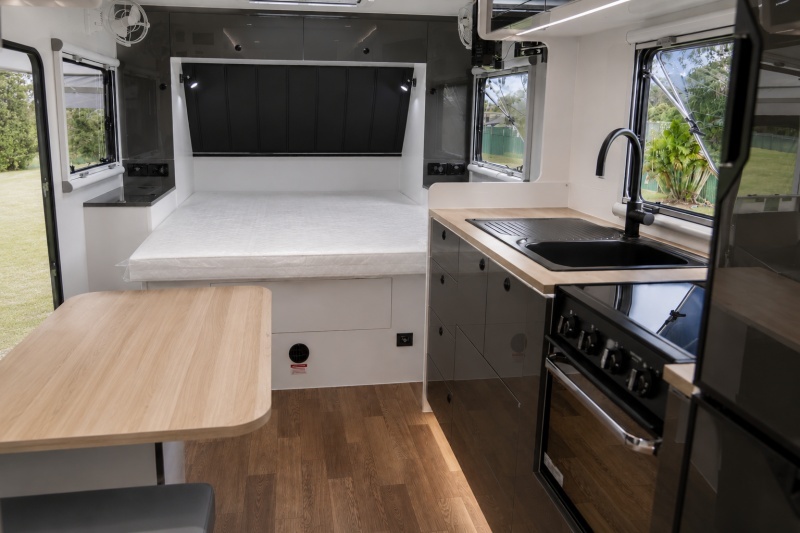
An internal kitchen places the main cooking and food-preparation equipment inside the caravan.
Depending on the model, it may include:
Sink
Cooktop
Refrigerator
Storage cabinets
Worktop
Microwave or other appliances
The main advantage is convenience in different weather conditions.
Customers can prepare food without relying entirely on an outdoor setup.
For dealers targeting family touring, longer trips or colder climates, this can be an important selling point.
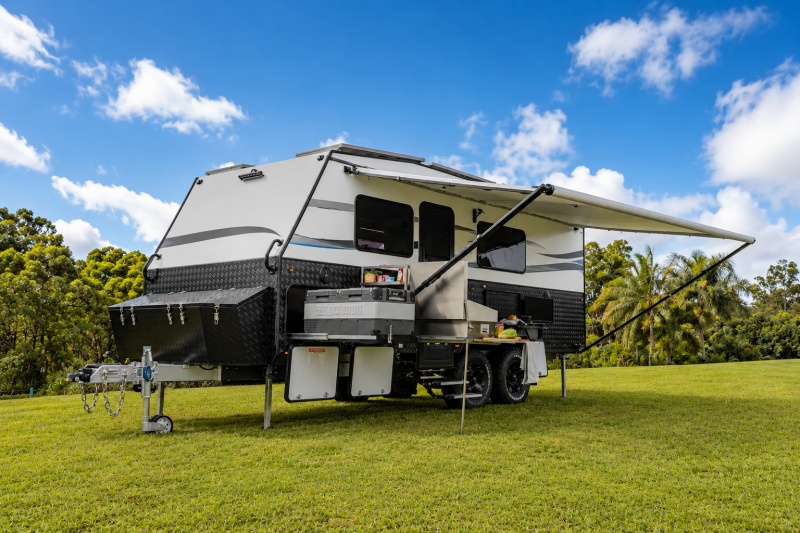
An external kitchen is accessed from outside the caravan, often through a side compartment or slide-out arrangement.
It may include:
Cooktop
Sink
Preparation surface
Storage
Refrigerator or fridge access
This configuration supports customers who prefer outdoor cooking and campsite living.
It can also reduce the amount of interior floor space dedicated to cooking equipment.
Weather is one of the clearest differences between the two layouts.
An internal kitchen allows customers to cook when conditions outside are:
Cold
Windy
Rainy
Dusty
This can make the caravan more practical for year-round travel.
Dealers operating in markets with variable weather may therefore find an internal kitchen easier to position as an all-season feature.
For many off road caravan customers, outdoor living is part of the product experience.
An external kitchen allows cooking close to:
Awning area
Outdoor tables
Camping chairs
Family activity areas
It also keeps much of the cooking activity outside the sleeping and living space.
For markets where customers frequently camp in warm climates, this can be attractive.
Every internal feature consumes space.
In a compact caravan, a larger internal kitchen may compete with:
Seating
Storage
Beds
Bathroom space
An external kitchen can help free interior space for other functions.
This is especially relevant when dealers are developing smaller caravan models where every part of the floor plan matters.
As caravan size increases, dealers have more flexibility.
A larger family caravan may have enough interior space for:
Permanent beds
Bathroom
Seating
Storage
Full internal kitchen
without making the living area feel excessively restricted.
This is one reason kitchen strategy should be considered together with caravan size rather than treated as an isolated option.
A dealer does not necessarily have to choose one kitchen philosophy for the entire range.
For example:
Compact Touring Model
External or simplified kitchen to maximize interior space.
Mid-Size Model
Internal kitchen with essential appliances.
Large Family Model
More complete internal kitchen, potentially with selected external cooking equipment as an option.
This creates genuine differentiation between models.
It is also possible to provide both internal and external cooking facilities.
This sounds attractive because the caravan offers more equipment.
But dealers should consider whether customers will pay for both.
Duplicating:
Sinks
Cooktops
Refrigeration
Storage
can increase cost and weight.
A dual-kitchen configuration should therefore solve a real customer requirement rather than simply making the specification list longer.
Cooking equipment may not seem like a major weight issue individually, but a complete kitchen package can include:
Refrigerator
Microwave
Cooktop
Sink
Water system
Cabinets
Worktops
Drawers
Additional external kitchen equipment adds further weight.
Dealers should therefore consider kitchen configuration when reviewing the final caravan payload and weight specification.
Customers do not only need a place to cook.
They also need space for:
Food
Cookware
Plates
Cups
Utensils
Cleaning products
A kitchen with many appliances but insufficient storage may look impressive in photographs while being less practical in real use.
For dealer product planning, storage design should be reviewed together with the appliance list.
Refrigerator size and position can influence:
Cabinet layout
Walking space
Electrical demand
Storage
A larger refrigerator may appeal to families and customers taking longer trips, but it also consumes more space and energy.
Dealers should specify refrigerator capacity according to the intended product segment instead of automatically selecting the largest option.
Different appliances create different power requirements.
A dealer specification may include:
Refrigerator
Microwave
Induction equipment
Electric appliances
The battery, inverter and shore-power configuration should therefore be considered together with the appliance package.
Adding equipment without reviewing electrical demand can create an unbalanced specification.
Internal cooking introduces:
Heat
Moisture
Odours
Therefore, ventilation and easy-to-clean surfaces become important parts of the design.
An external kitchen reduces some of these issues inside the caravan, although outdoor equipment must instead cope with exposure to the external environment.
Again, each design creates different priorities rather than a simple good-versus-bad comparison.
Kitchen layouts are highly visual.
A customer visiting a showroom can quickly understand:
Worktop space
Drawer access
Refrigerator position
Storage capacity
Cooking location
For this reason, dealers should think about how the kitchen works physically—not only how many appliances appear on the specification sheet.
A well-designed demonstration caravan can help customers understand the practical difference between competing layouts.
For repeat wholesale orders, dealers may benefit from defining standard kitchen packages.
For example:
Kitchen Package A
Basic internal kitchen for compact models.
Kitchen Package B
Larger internal kitchen for family caravans.
Kitchen Package C
External cooking package for outdoor-focused models.
This makes future production easier to repeat and helps the dealer maintain consistent retail specifications.
An internal kitchen may be more suitable when customers prioritize:
All-weather travel
Family use
Longer trips
Indoor convenience
An external kitchen may be attractive when customers prioritize:
Outdoor living
Compact interior design
Warm-climate touring
Campsite cooking
A combination may work for selected premium models, but dealers should evaluate whether the additional cost and weight are commercially justified.
LZM works with importers, dealers and distributors on different caravan layouts and equipment packages.
Businesses developing their own product range can review the LZM Off Road Caravan Manufacturer Range before defining the kitchen and interior configuration for their market.
OEM discussions can include:
Internal kitchen
External kitchen
Refrigerator
Cabinet configuration
Storage
Electrical equipment
Water system
Interior layout
Dealer branding
Dealers considering larger family-oriented layouts can also use the LZM 21ft Off Road Caravan as a visual reference while comparing different models and layouts.
The choice between an internal kitchen and external kitchen off road caravan should follow the target market.
An internal kitchen offers convenience and weather protection.
An external kitchen supports outdoor living and can preserve valuable interior space.
For dealers, the strongest approach is not to install the maximum amount of kitchen equipment in every caravan. It is to match caravan size, customer use, climate, retail price and equipment package.
A clearly positioned kitchen configuration makes the caravan easier to understand, easier to sell and easier to reorder.