Welcome: Laizhou Machinery Group



When an off road caravan dealer selects models for a local market, axle configuration is an important purchasing decision.
Two caravans may look similar from the outside but use very different running configurations.
One may use a single axle, while another uses a tandem axle.
For dealers, the question is not simply:
Which axle configuration is stronger?
A better question is:
Which configuration is appropriate for the caravan's size, final weight, intended use and target customer?
The correct answer depends on the complete product rather than one isolated component.
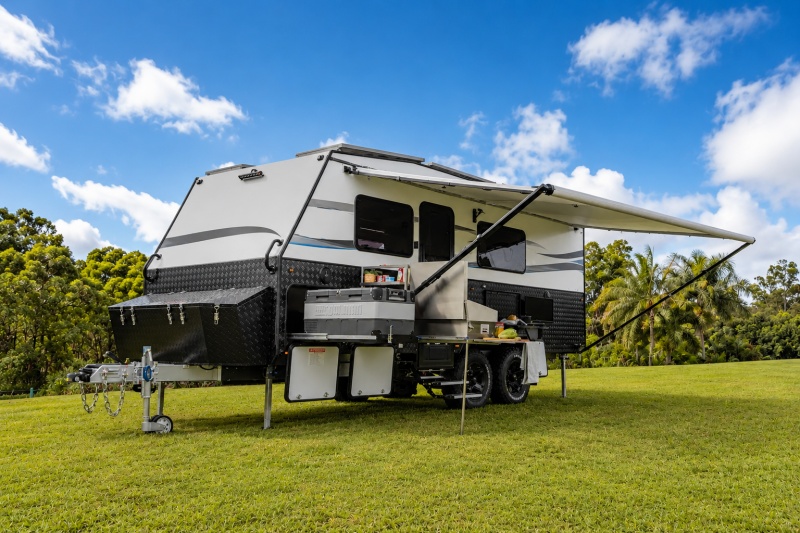
A single axle caravan uses one axle line under the trailer.
This configuration is commonly associated with:
Smaller caravan platforms
Lower finished mass
Simpler running equipment
Lower component count
For dealers, a single axle model may be attractive when the target customer values:
Compact size
Easier maneuvering
Lower purchase price
Simpler product positioning
However, suitability depends on the final caravan specification and applicable market requirements.
A tandem axle caravan uses two axle lines.
This configuration is commonly used on:
Larger caravans
Heavier caravans
Family models
Higher-equipment configurations
A tandem axle platform can support a different product category from a small single axle model.
But it also adds:
Components
Weight
Tyres
Brakes
Maintenance points
Therefore, tandem axle should not be treated as automatically superior in every application.
As caravan length and mass increase, the appropriate running configuration may change.
A compact couples' caravan may be well suited to a single axle platform.
A larger family caravan with:
More interior space
Larger water tanks
Additional batteries
More appliances
Greater storage
may require a different approach.
Dealers should therefore evaluate axle configuration together with the finished caravan, not only the body length.
A caravan may look relatively compact but contain a heavy equipment package.
For example:
Large lithium battery bank
High solar capacity
Large freshwater tanks
Air conditioning
Multiple appliances
Spare wheels
can significantly increase finished mass.
This is why dealers should avoid choosing axle configuration based only on exterior dimensions.
The complete production specification matters.
A caravan must carry not only its installed equipment but also customer cargo.
Customers may add:
Water
Food
Clothing
Outdoor furniture
Tools
Recovery equipment
Personal belongings
A dealer should therefore consider:
finished caravan mass + expected customer payload
when discussing axle and suspension requirements.
For dealers, single axle caravans can be useful for creating a distinct product category.
For example:
Compact Off Road Caravan
Target customer:
Couples
Smaller tow vehicles
Buyers prioritizing maneuverability
Customers wanting a simpler touring setup
This creates a different market position from a larger tandem axle family caravan.
A tandem axle caravan may be appropriate for larger configurations designed around:
Four-person layouts
Bunk beds
Larger storage
Larger water capacity
More equipment
From a dealer perspective, this can help create a clear product ladder.
For example:
Compact Single Axle Model
then
Mid-Size or Large Tandem Axle Model
Customers can more easily understand why the larger model occupies a higher price and capability position.
Single axle caravans may be easier to maneuver in certain situations because there are fewer tyres resisting tight turns.
This can be relevant for:
Storage
Campsites
Dealer yards
Tight access areas
However, actual towing and maneuverability depend on the complete caravan geometry, towing vehicle and operating conditions.
Dealers should avoid turning one design characteristic into an absolute marketing claim.
With two axle lines, tyre scrub can occur during tight turns.
This is a normal characteristic of tandem axle trailer geometry.
For dealers, this means customer education may be useful.
A buyer moving from a small single axle caravan to a larger tandem axle caravan may notice a different feel during:
Tight reversing
Yard maneuvering
Campsite positioning
This does not mean something is wrong with the caravan.
It is part of the different configuration.
A single axle caravan may require:
Two road tyres
Plus spare tyre depending on configuration
A tandem axle caravan typically has more road tyres.
Over time, this affects:
Replacement tyre cost
Inspection
Maintenance
Spare strategy
These are relatively small costs compared with the complete caravan, but they still matter to customers and dealers.
Axle configuration and braking need to be considered together.
Depending on the caravan and destination market, braking systems may differ in:
Type
Capacity
Control
Regulatory requirements
Dealers should not assume that a braking specification suitable for one model automatically applies to another.
This is particularly important when a caravan is heavily customized.
Off road caravan buyers often pay close attention to suspension.
But suspension should not be discussed separately from:
Axle configuration
Finished weight
Intended terrain
Tyres
Chassis
Customer use
A suspension system that is appropriate for one caravan may not be the correct solution for another model.
For OEM purchasing, dealers should discuss the complete running system rather than selecting suspension only by brand or appearance.
This is an important point for dealer marketing.
A tandem axle caravan is not automatically "more off road" simply because it has more wheels.
Off road performance can also depend on:
Ground clearance
Departure angle
Chassis design
Suspension travel
Tyres
Weight distribution
Overall dimensions
A smaller single axle caravan may suit certain rough-access situations very well.
A larger tandem axle caravan may serve a different customer who prioritizes interior capacity.
Axle count and ground clearance are related to the running configuration but are not the same thing.
Dealers should review:
Lowest structural points
Suspension components
Tank positioning
Plumbing protection
Rear overhang
This provides a more complete view of how the caravan may perform on uneven terrain.
As caravan length increases, rear geometry can become increasingly important.
A longer body may create more rear overhang behind the axle group.
This can affect clearance when travelling over:
Steep driveways
Uneven tracks
Dips
Dealers evaluating larger tandem axle caravans should therefore look beyond total length and consider overall geometry.
Adding another axle does not eliminate the need for good weight distribution.
Heavy equipment may include:
Batteries
Water tanks
Spare wheels
Appliances
Storage
These should be positioned with consideration for the overall caravan design.
A poor layout cannot simply be corrected by adding more axle capacity.
A compact single axle model may offer advantages in:
Lower component count
Simpler spare-parts management
Lower tyre replacement cost
Clearer product specification
For dealers introducing a new brand, this can make the entry model easier to understand and support.
Larger dealer models may require room for:
More batteries
More water
Larger kitchen
Bunks
Larger bathroom
Additional storage
These products may naturally move toward tandem axle configurations as the completed specification becomes larger and heavier.
Again, the axle configuration should follow the product—not the other way around.
Suppose the dealer begins with a standard model.
Then adds:
200 L more water
Larger batteries
Additional spare wheel
Larger refrigerator
Air conditioning
The running specification should be reviewed after these changes.
OEM customization can alter the assumptions used when the base model was originally designed.
A useful product range might look like:
For couples and smaller touring configurations.
For customers wanting more living space and equipment.
For additional sleeping capacity, storage and longer-trip capability.
This is easier for sales teams to explain than offering several models with very similar positions.
A tandem axle model may cost more, but not simply because it has another axle.
Larger models may also require:
Larger chassis
More materials
More interior equipment
Additional brakes
More tyres
Larger suspension system
Dealers should therefore avoid presenting the price difference as the cost of "one extra axle."
It reflects the complete vehicle configuration.
More running components mean more inspection points.
Depending on the product, dealers may need to educate customers about checking:
Tyres
Wheel fasteners
Bearings
Braking components
Suspension
Good after-sales information helps customers understand that an off road caravan requires ongoing maintenance.
A compact caravan may carry one spare wheel.
Customers travelling in remote areas may request additional spare capacity.
However, adding spare wheels increases:
Weight
Cost
Mounting requirements
Dealers should decide whether additional spares should be:
Standard
Optional
Part of an off-grid or remote-travel package
rather than installing maximum equipment on every unit.
Axle load, braking, registration and weight requirements vary by destination market.
Importers should confirm the applicable local rules before ordering.
Relevant areas may include:
Maximum axle loads
Braking requirements
Coupling requirements
Lighting
Tyres
Vehicle mass
Registration category
The factory's technical information should support this process, but final local compliance must be checked for the destination market.
Before ordering, dealers should ask:
What is the finished caravan weight?
What equipment is included in that weight?
What payload is expected?
Why is this model single axle or tandem axle?
What axle capacity is used?
What suspension configuration is used?
What braking system is supplied?
What tyre size is fitted?
How many spare wheels are included?
What happens if the dealer adds more water or batteries?
How is weight distributed?
What local compliance information will be required?
These questions help dealers understand the complete running system.
A new dealer should not begin by deciding:
We only want tandem axle caravans.
or
Single axle is cheaper, so we only want single axle.
Instead, start with:
Customer segment
Caravan size
Required layout
Equipment package
Expected loaded weight
Intended use
The correct axle configuration should follow from those requirements.
LZM offers different caravan platforms for dealers, importers and distributors.
Businesses comparing sizes and running configurations can review the LZM Off Road Caravan Manufacturer Range before defining the final specification.
Dealer discussions can include:
Caravan size
Single or tandem axle configuration
Suspension
Braking
Payload
Battery and solar
Water capacity
Interior layout
OEM branding
For dealers evaluating a larger caravan configuration, the LZM 21ft Off Road Caravan provides a useful visual reference for a larger platform before comparing other available sizes within the broader range.
The final axle and running specification should be based on the complete dealer configuration rather than caravan length alone.
For dealers, the single axle vs tandem axle decision should not be reduced to:
one axle is cheaper or two axles are stronger.
The correct configuration depends on:
caravan size + finished weight + payload + layout + equipment + intended customer use.
A compact single axle model can provide a strong product for couples and customers prioritizing maneuverability.
A larger tandem axle model can support family layouts and higher-equipment configurations.
The most important principle is simple:
Select the caravan first as a complete commercial product, then make sure the axle, suspension, braking and weight configuration are appropriate for that product.