Welcome: Laizhou Machinery Group



For an off road caravan dealer, the lowest factory price does not automatically create the best business.
A caravan may look inexpensive at the quotation stage, but the dealer still needs enough commercial margin to cover:
International freight
Import costs
Local transport
Marketing
Showroom expenses
Sales staff
Warranty support
Spare parts
Customer service
This means dealers should not evaluate a wholesale quotation only by asking:
How much does each caravan cost?
A more useful question is:
After all costs are included, does this model leave enough margin to support a sustainable dealership?
That is the real purpose of evaluating caravan dealer margin.
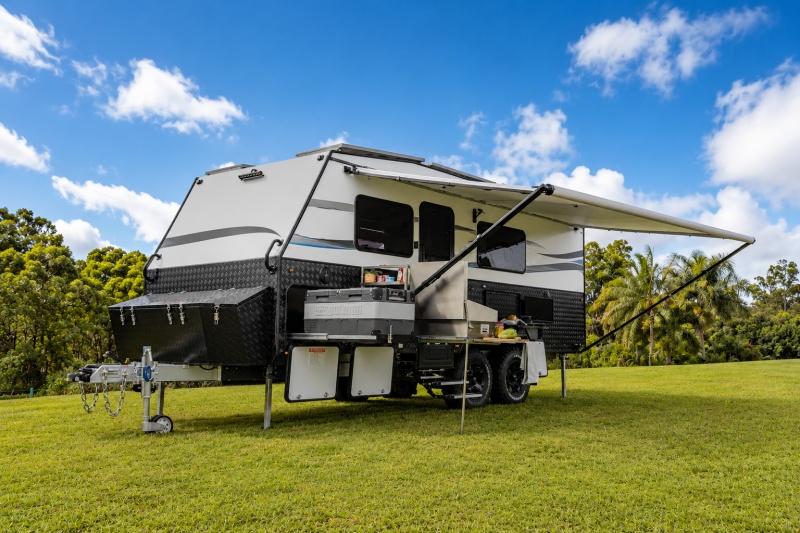
A manufacturer's quotation is only one part of the dealer's total cost.
Depending on the purchasing terms and destination market, additional costs may include:
Inland transport in China
Export handling
Ocean freight
Insurance
Port charges
Duties
Taxes
Customs clearance
Local delivery
Inspection
Compliance work
The dealer's commercial decision should therefore be based on landed cost, not simply the factory price.
Landed cost is the total cost of bringing the caravan to the dealer's market and making it commercially available.
In simplified form:
Factory Price + Logistics + Import Costs + Local Costs = Landed Cost
The exact components vary by country.
A quotation that appears cheaper at EXW level may not remain cheaper after transport and import costs are included.
Some buyers calculate margin very simply:
Retail Price – Purchase Price = Profit
For a real dealership, this is incomplete.
Gross margin may also need to support:
Marketing
Sales salaries
Workshop
Warranty claims
Spare parts
Financing cost
Inventory holding
Rent
Administration
This is why a dealer requires more margin than an end customer might expect.
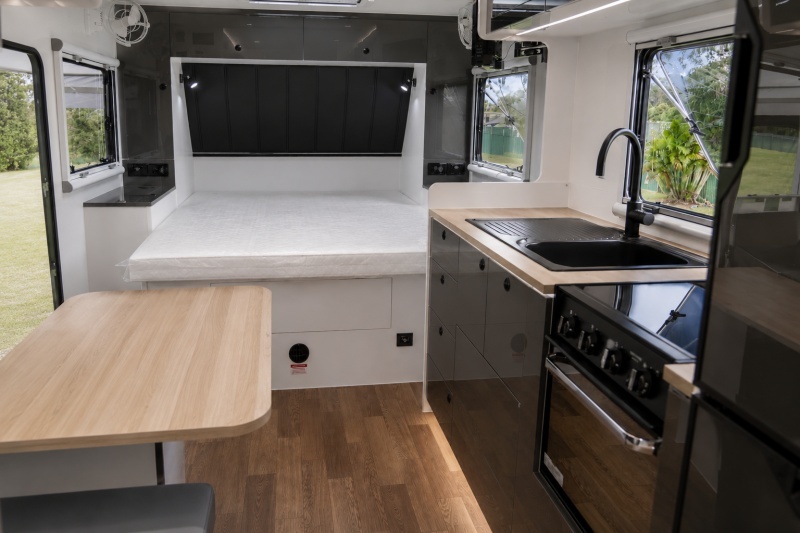
Caravans are relatively high-value products.
If a unit remains unsold for several months, the dealer still has capital tied up in inventory.
This can create costs through:
Financing
Storage
Insurance
Showroom space
Opportunity cost
A product with a high theoretical margin but very slow inventory turnover may be less attractive than a slightly lower-margin model that sells consistently.
Consider two models.
Model A
Higher gross margin, but difficult to sell.
Model B
Slightly lower gross margin, but regular demand and faster turnover.
Model B may ultimately produce better annual business performance.
Dealers should therefore evaluate:
margin per unit + expected sales speed
rather than margin per unit alone.
A dealer cannot accurately compare prices if the caravan specifications are different.
One quotation may include:
Lithium batteries
Solar
Larger water tanks
Air conditioning
Premium appliances
Additional accessories
while another quotation includes a simpler base configuration.
The cheaper caravan may only be cheaper because less equipment is included.
Dealers should compare like-for-like specifications whenever possible.
One of the easiest ways to damage dealer margin is to add every available option.
A caravan may be equipped with:
Very large battery system
Maximum solar
Multiple spare wheels
Large water capacity
Premium appliances
Extra accessories
These features can increase purchase cost significantly.
The dealer then has to ask:
Will the customer actually pay more for these features?
If not, the extra equipment reduces margin.
An option can be justified if it:
Solves a customer problem
Supports a higher retail price
Differentiates the product
Improves usability
Reduces after-sales problems
An option should not be included simply because it is available.
A disciplined specification can protect both dealer margin and product clarity.
Dealers may structure the range using defined equipment levels.
For example:
Focused on essential equipment and competitive retail pricing.
Adds selected comfort and convenience features.
Adds appropriate battery, solar and water capacity for remote travel.
This creates clear price points without forcing every customer to pay for the maximum specification.
A dealer cannot determine wholesale purchasing strategy without understanding likely retail pricing.
Important questions include:
What do competing caravans sell for?
What price range do local customers accept?
Is the new brand premium, mid-market or value-oriented?
How much extra will customers pay for specific features?
Is financing commonly used?
The wholesale specification should be designed backwards from realistic retail positioning.
Two caravans with similar external dimensions can have very different:
Chassis
Suspension
Battery systems
Water capacity
Appliances
Interior equipment
Therefore, simply matching a competitor's retail price may be misleading.
Dealers should compare both:
price and what the customer receives for that price.
International freight is especially important for large products.
Caravan dimensions can affect:
Shipping method
Freight rate
Loading efficiency
Port handling
For this reason, model selection and logistics should be considered together.
A caravan that is slightly cheaper to manufacture but substantially more expensive to transport may not provide the best landed-cost result.
Ordering more units can sometimes improve purchasing or logistics efficiency.
But it also increases:
Inventory value
Capital commitment
Storage requirement
Exposure if the model sells slowly
The correct quantity is therefore not necessarily the largest quantity that produces a lower unit cost.
Dealers need to balance unit economics and inventory risk.
A caravan is not a one-time sale.
Customers may return with issues involving:
Electrical equipment
Plumbing
Appliances
Hardware
Seals
Other components
Even when replacement parts are supplied by the manufacturer, the dealer may still have local:
Labour
Diagnosis
Administration
Customer communication
costs.
The dealer's gross margin needs enough room to absorb normal after-sales activity.
A distributor may need to keep selected components in stock.
This ties up a relatively small amount of capital compared with complete caravans, but it is still part of the cost structure.
Useful parts may include:
Pumps
Switches
Lights
Seals
Hardware
Plumbing components
The exact stock should follow the actual models being sold.
Using common components across multiple caravan models can reduce after-sales complexity.
If three dealer models use the same:
Water pump
Switches
Lighting
Selected electrical equipment
Interior hardware
the dealer can simplify spare-parts inventory.
This reduces both service complexity and working capital.
A dealer may believe that more models always create more sales.
But each additional SKU can require:
Stock
Marketing
Sales training
Spare parts
Documentation
If two models appeal to almost the same customer, one may simply steal sales from the other.
A smaller range of clearly differentiated models can sometimes produce stronger commercial results.
For example:
Compact Couples Model
Entry or lower-mid price position.
Mid-Size Touring Model
Mainstream core product.
Family Model
Higher-value configuration with more space and sleeping capacity.
The customer should understand why each model costs more than the previous one.
If the price difference is unclear, the dealer may struggle to upsell.
Private-label products may give dealers more control over:
Retail positioning
Promotions
Model naming
Product packages
The dealer is not necessarily competing against identical products sold by another local retailer.
This can support stronger pricing discipline.
However, private labeling only works if the underlying product and after-sales system are reliable.
OEM customization can differentiate a caravan, but excessive custom work can also increase:
Development cost
Production complexity
Component cost
Lead time
Dealers should focus customization on features that have a clear commercial benefit.
A unique feature that customers do not understand may not justify its cost.
Before finalizing a wholesale order, the dealer can estimate:
Expected Retail Price
minus
Landed Cost
minus
Expected Sales and After-Sales Costs
This creates a more realistic view of the business.
The goal is not to calculate the exact final profit before the product is launched.
The goal is to identify whether the commercial structure is fundamentally viable.
A dealer compares two suppliers.
Supplier A is USD 3,000 cheaper per caravan.
The dealer immediately selects Supplier A.
Later, the dealer discovers that the cheaper quotation excludes:
Larger battery
Solar
Air conditioner
Several standard accessories
Adding equivalent equipment removes most of the price difference.
This is why wholesale comparison should start with a standardized specification.
A dealer first defines:
Target retail customer
Required layout
Standard equipment
Optional equipment
Target retail price
Expected landed cost range
The manufacturer then quotes against that defined specification.
Now the dealer can compare suppliers on a much more meaningful basis.
For a new brand, customers may hesitate to order based only on photographs.
A showroom or demonstration caravan allows them to inspect:
Finish
Layout
Storage
Kitchen
Bathroom
Equipment
This can help the dealer justify the retail price and reduce customer uncertainty.
The demo unit therefore has commercial value beyond its direct resale value.
A new caravan brand may require investment in:
Website
Social media
Trade shows
Local events
Photography
Video
Advertising
These costs are part of market entry.
Dealers should not assume that a large factory-to-retail price difference automatically becomes net profit.
A supplier relationship that reduces operational problems can have financial value.
For example:
Consistent specifications
Clear production communication
Spare-parts support
Repeatable models
Technical information
can reduce dealer time and service complexity.
These benefits may not appear on the original quotation, but they influence long-term profitability.
The first shipment includes uncertainty.
By the second or third order, the dealer should have better data on:
Sales speed
Best-selling models
Customer preferences
Warranty issues
Spare-parts demand
Real landed cost
This allows purchasing decisions to become increasingly data-driven.
Price negotiation is reasonable.
But it works best after the required product is clearly defined.
A productive negotiation can focus on:
Order quantity
Standardized specification
Repeat-order plan
Model combination
Annual purchasing volume
rather than simply asking for the lowest possible price before defining the product.
Before placing an order, ask:
What is included in the quoted price?
Which options are additional?
Which specification is being quoted?
What is the production quantity?
Does customization affect price?
What is the estimated shipping method?
Which spare parts should be stocked?
What warranty support is provided?
Can the same specification be repeated?
What costs are likely to remain after import?
What retail price can the local market realistically support?
These questions help dealers evaluate the actual commercial opportunity.
LZM works with dealers, importers and distributors developing off road caravan product ranges for their local markets.
Businesses comparing Wholesale Off Road Caravans from China can review available caravan platforms before defining their target specification and retail position.
Wholesale discussions can include:
Caravan size
Layout
Equipment package
Dealer branding
Battery and solar
Water system
Spare parts
Planned order quantity
The objective is to establish a configuration that is both attractive to customers and commercially sustainable for the dealer.
Dealers evaluating a larger model can also review the LZM 21ft Off Road Caravan for product images and configuration ideas before comparing it with other models in the wider range.
A dealer's final selection should be based on local retail positioning and margin rather than simply choosing the largest or most heavily equipped caravan.
When requesting wholesale pricing, dealers can provide:
Destination country
Existing caravan business
Target customers
Preferred caravan sizes
Required equipment
Branding requirements
Planned initial order quantity
Expected annual purchasing volume
This makes it easier to prepare a quotation against a commercially relevant specification.
For an importer, caravan dealer margin begins with the wholesale quotation—but it does not end there.
Real dealership economics depend on:
factory price + logistics + import cost + inventory + marketing + warranty + spare parts + retail positioning.
The cheapest caravan is not automatically the most profitable caravan.
A stronger purchasing strategy is to define the right product, calculate realistic landed cost, protect enough margin for after-sales support and build a range that can generate repeat sales.
For a dealer, sustainable profit is more important than winning the lowest factory price.