Welcome: Laizhou Machinery Group



When comparing off road caravans from different manufacturers, dealers often receive a specification sheet containing a vehicle weight.
That number is useful—but by itself it can be misleading.
The caravan that eventually reaches a customer may also carry:
Fresh water
Batteries
Solar equipment
Gas cylinders where applicable
Spare wheels
Appliances
Outdoor equipment
Food
Clothing
Personal belongings
For an importer, the important question is therefore not simply:
How much does the caravan weigh?
It is:
How much usable payload remains after the dealer's final specification has been installed?
That distinction becomes particularly important when developing heavily equipped or off-grid caravan models.
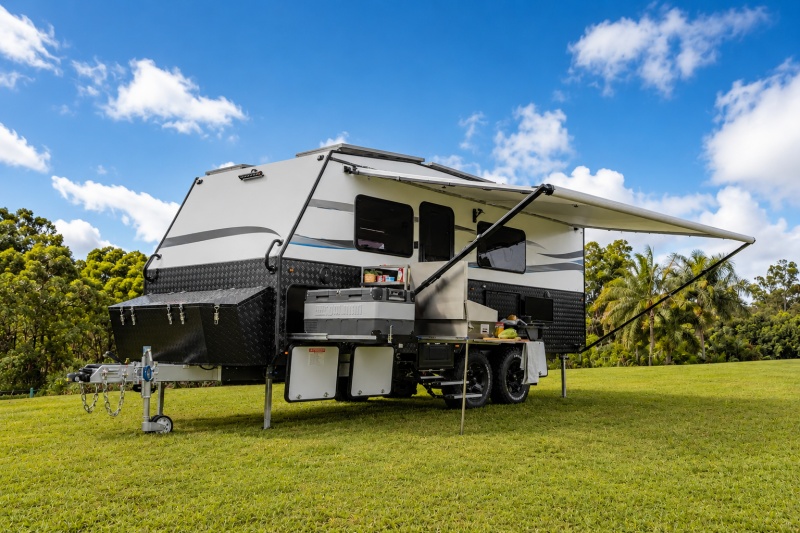
A base caravan and a dealer's final retail model may not have the same weight.
Suppose the dealer adds:
Larger battery bank
Additional solar panels
Larger water tanks
Air conditioning
Additional appliances
Second spare wheel
Exterior accessories
Each individual upgrade may appear reasonable.
Together, they can materially change the finished caravan.
This is why dealers should evaluate weight after the equipment package has been defined, not only at the beginning of model selection.
In practical terms, payload is the amount of additional mass available for equipment and cargo within the applicable weight limits of the caravan.
Depending on the destination market, terminology and regulatory definitions can differ.
Dealers should therefore confirm the locally applicable definitions rather than assuming terminology used by an overseas manufacturer is identical to local registration terminology.
The important commercial principle remains the same:
A caravan needs enough usable carrying capacity for the way customers are expected to use it.
Off road and remote-travel customers may carry more equipment than conventional touring customers.
Typical additional loads can include:
More water
Larger batteries
Recovery equipment
Tools
Outdoor furniture
Food
Camping equipment
Additional spare wheel
Personal gear
Therefore, a caravan marketed for extended remote travel needs a realistic payload strategy.
A long options list is less useful if the customer has very little practical carrying capacity remaining after those options are installed.
Water is one of the clearest examples.
Approximately:
1 litre of water ≈ 1 kilogram
Therefore:
100 L ≈ 100 kg
200 L ≈ 200 kg
before considering the tank, mounting hardware or plumbing itself.
A dealer requesting larger freshwater capacity should therefore ask two questions:
How much water will the customer realistically need?
and
How does that capacity affect the finished caravan weight and usable payload?
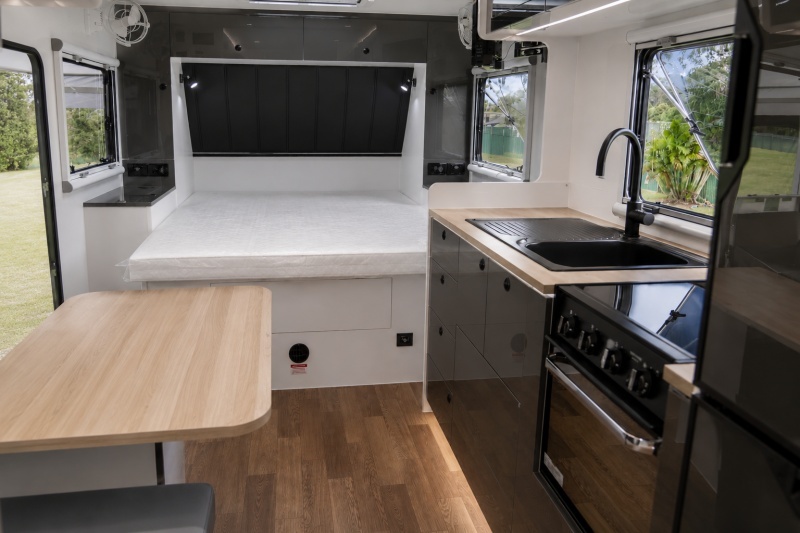
Large tank capacity is attractive in marketing material, especially for off-grid caravans.
But maximum capacity should not become a competition between specification sheets.
For some customers, additional water is extremely valuable.
For others, the added:
Weight
Cost
Space requirement
may provide limited benefit.
The correct capacity should follow the caravan's intended use.
Battery upgrades are another common dealer request.
A larger battery bank can support:
Longer off-grid operation
Appliances
Electronics
Inverter loads
But battery capacity does not come without weight.
The complete electrical system can also include:
Battery modules
Inverter
Charger
DC-DC equipment
Cables
Mounting hardware
Dealers should therefore evaluate an electrical upgrade as a system rather than only comparing battery capacity figures.
Solar panels are relatively easy to market because customers understand the benefit of renewable charging.
However, increasing solar capacity can affect:
Roof space
Weight
Wiring
Charging equipment
Installation complexity
The correct solar specification should be coordinated with battery capacity and expected customer consumption.
Simply maximizing panel wattage does not automatically create a better caravan.
One additional appliance may have little effect on the complete caravan.
Several upgrades can.
Depending on the dealer specification, equipment may include:
Refrigerator
Air conditioner
Microwave
Washing machine
Cooking equipment
Entertainment equipment
Hot-water equipment
Dealers should consider the combined effect of these items on:
Weight
Electrical demand
Interior space
Retail cost
Off road caravans may be configured with one or more spare wheels.
A second spare can be valuable for customers travelling in remote areas.
But wheels and tyres are relatively heavy.
They also need suitable mounting positions.
This affects not only total mass but potentially weight distribution.
The location of heavy equipment matters.
Large storage compartments are attractive selling features.
But storage space encourages customers to fill it.
A caravan may have:
Large front storage
Under-bed compartments
External lockers
Overhead cabinets
Rear storage
From a retail perspective, this looks excellent.
From an engineering and dealer perspective, another question is required:
How much can customers actually carry?
Physical storage volume should therefore be considered together with payload.
A family caravan may carry significantly more personal equipment than a couples' model.
Four occupants can mean more:
Clothing
Bedding
Food
Water
Outdoor equipment
Electronics
This is why sleeping capacity should not be treated only as an interior-layout decision.
A 4 berth caravan should be evaluated as a vehicle intended to support four people's equipment and daily use.
It would be incorrect to assume that only family caravans need careful payload planning.
A premium 2 berth model may include:
Larger batteries
More solar
Larger refrigerator
Air conditioning
Premium furniture
Additional appliances
More water
Exterior accessories
Therefore, a two-person caravan can also become heavily equipped.
The final specification matters more than berth count alone.
This is especially important for OEM programs.
A factory may provide a weight for a standard model.
The dealer then requests:
Larger battery system
Different appliances
Extra water tank
Additional spare wheel
Exterior kitchen
Awning
Additional accessories
The original standard-model weight should not automatically be treated as the final dealer-model weight.
For wholesale purchasing, the dealer should identify the configuration being quoted and evaluated.
When comparing two caravan manufacturers, dealers should determine what is actually included.
Manufacturer A may quote a lighter caravan because the standard configuration includes less equipment.
Manufacturer B may appear heavier because its quoted configuration already includes additional:
Batteries
Water capacity
Appliances
Accessories
Comparing a base model with a fully equipped model produces little useful information.
The specification and weight should be evaluated together.
Total mass is not the only consideration.
Where heavy equipment is installed can affect the caravan.
Relevant items may include:
Water tanks
Batteries
Spare wheels
Storage compartments
Appliances
These components should not be positioned only according to where they physically fit.
Their placement needs to be considered as part of the overall caravan design.
Dealers often request rear-mounted equipment such as:
Spare wheels
Toolboxes
Storage
Other accessories
These can be useful.
But adding significant mass at the extreme rear of a caravan is not simply an aesthetic or storage decision.
OEM discussions should consider the complete configuration and distribution of mass.
A heavily equipped off road caravan needs a running configuration appropriate for the finished product.
Relevant areas may include:
Chassis
Axles
Suspension
Wheels
Tyres
Braking system
Coupling
Dealers should avoid selecting major running components independently from the final caravan specification.
The caravan should be considered as one integrated system.
Payload can also become part of the commercial positioning.
For example, a caravan designed for remote touring may need greater practical carrying capacity than a model intended primarily for shorter recreational trips.
A dealer could therefore differentiate products by more than:
Length
Number of beds
Interior appearance
The intended use and carrying capability can also help define the product.
A specification sheet may advertise:
Huge water capacity
Large battery bank
Multiple spare wheels
Extensive storage
Many accessories
Individually, each feature sounds attractive.
But dealers should ask whether customers can practically use all of them together within the applicable limits.
A well-designed caravan specification requires balance, not simply the largest number in every category.
The best time to consider weight is before the final production specification is approved.
Not after the caravan has been completed.
During OEM discussions, dealers should identify:
Required equipment
Optional equipment
Water capacity
Battery system
Solar
Spare wheels
Major appliances
Exterior accessories
The resulting configuration can then be evaluated as a complete product.
One useful dealer strategy is to divide equipment into:
Standard Equipment
Installed on every unit of that model.
Optional Equipment
Selected according to customer or dealer requirements.
This makes it easier to understand how different configurations may affect:
Weight
Cost
Electrical requirements
Product positioning
It also makes the retail specification easier for sales staff to explain.
If every customer can select dozens of independent options, the dealer may eventually sell many slightly different caravans.
That creates complexity in:
Weight records
Spare parts
Warranty
Product documentation
Pricing
A smaller number of standardized equipment packages can be easier to manage.
For example:
Touring Package
Family Package
Off-Grid Package
Each package can have a defined equipment specification.
When reviewing a quotation, dealers should clarify whether a stated weight relates to:
Basic factory model
Quoted configuration
Completed production unit
This avoids making purchasing decisions based on a number that does not represent the caravan being ordered.
For customized products, final specifications should be considered when discussing weight information.
Weight terminology, registration requirements and allowable limits vary by market.
Importers should confirm applicable requirements with the relevant local authority or qualified compliance professional before ordering.
This may involve requirements related to:
Maximum permitted mass
Axle ratings
Coupling
Brakes
Dimensions
Registration categories
The manufacturer's technical information is an input to this process, not a substitute for destination-market compliance verification.
Before ordering an off road caravan, ask:
What configuration does the stated weight represent?
Which equipment is included?
What is the intended payload capacity?
How much freshwater can be carried?
What battery system is installed?
How many spare wheels are included?
Which appliances are standard?
Which accessories are optional?
How do OEM changes affect finished weight?
Where are major heavy components positioned?
Are axle and suspension specifications appropriate?
Can the same configuration be repeated in future orders?
What technical weight information can be provided for local compliance review?
These questions help dealers compare actual products rather than isolated numbers.
LZM supplies different caravan platforms for international dealers, distributors and importers.
Businesses comparing caravan dimensions, layouts and equipment packages can review the LZM Off Road Caravan Manufacturer Range before defining the final dealer specification.
OEM discussions can then consider the combined effect of:
Caravan size
Layout
Battery capacity
Solar
Water
Appliances
Spare wheels
Accessories
rather than selecting each feature independently.
Dealers evaluating a larger caravan platform can also review the LZM 21ft Off Road Caravan for product images and configuration reference, then compare it with other available models in the broader LZM caravan range.
The appropriate payload and equipment strategy should ultimately follow the dealer's selected model and target customer.
For dealers, off road caravan payload is not just another technical number on a specification sheet.
It connects directly to:
water + batteries + solar + appliances + storage + accessories + customer use + local compliance.
Adding more equipment can make a caravan more attractive, but every upgrade needs to be considered as part of the finished vehicle.
The goal should not be to create the caravan with the longest specification list.
It should be to create a balanced dealer product with useful equipment, practical carrying capacity and a clearly defined customer application.