Welcome: Laizhou Machinery Group



For a caravan dealer looking for a new overseas supplier, minimum order quantity is often one of the first commercial questions.
But asking only:
What is your MOQ?
does not tell the whole story.
For a dealer or importer, the more useful question is:
What first-order quantity gives us enough product to test the market without creating unnecessary inventory risk?
The answer depends on the market, caravan models, customization requirements, shipping economics and the dealer's existing sales network.
This makes off road caravan MOQ a commercial planning issue rather than simply a factory rule.
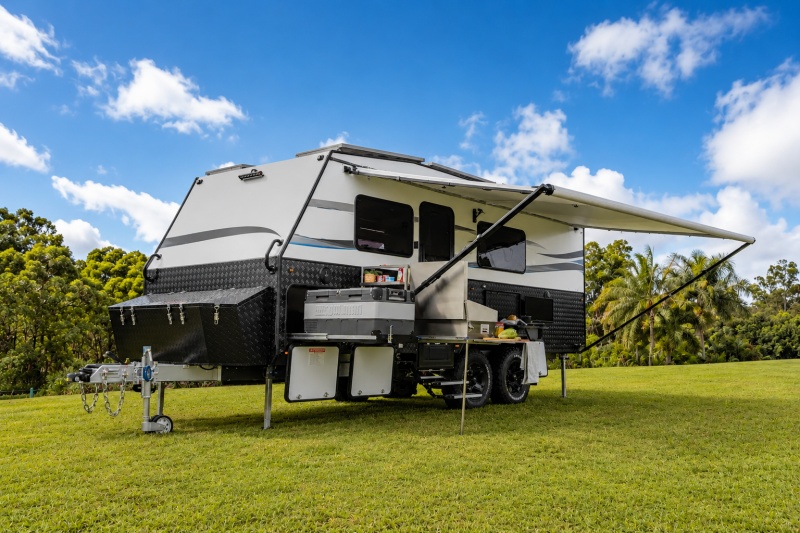
Manufacturers generally prefer repeatable production.
Producing a caravan involves coordination across:
Chassis and running equipment
Body production
Furniture
Electrical systems
Plumbing
Appliances
Interior materials
Exterior finishes
Quality control
When a dealer requests special specifications, additional procurement and production preparation may also be required.
For this reason, the commercially practical quantity can vary according to the model and level of customization.
This distinction is important.
MOQ means the minimum quantity the supplier is prepared to accept under a particular purchasing arrangement.
Recommended first-order quantity is a business decision made by the importer.
A factory may technically accept an order, but that does not automatically mean the quantity provides the best:
Shipping economics
Product selection
Dealer inventory
Market coverage
Likewise, ordering substantially more than the minimum is not automatically better.
The dealer still needs to sell the inventory.
A first shipment can be used to learn:
Which caravan size attracts the most enquiries?
Which layout do customers prefer?
Which equipment generates real buying interest?
What retail price can the market support?
Which objections appear during sales?
Which components require local support?
How quickly can inventory turn?
This information can be more valuable than maximizing the number of models in the first order.
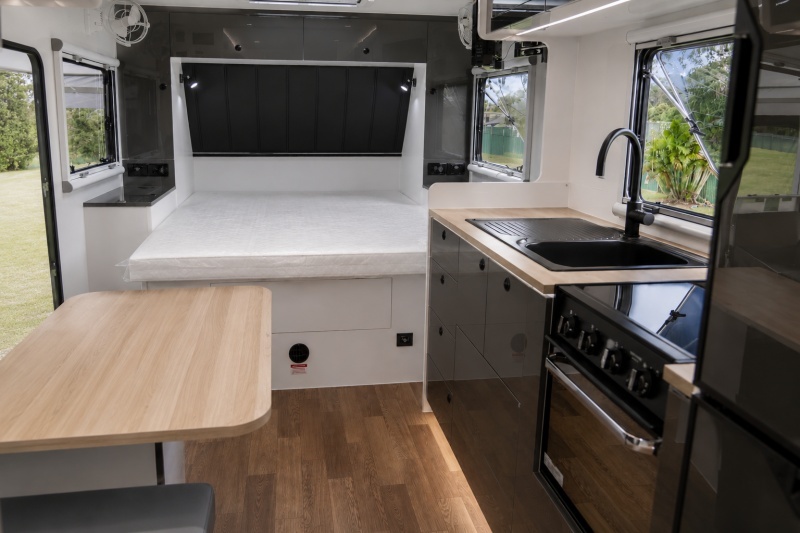
Suppose an importer wants to test:
12ft
15ft
17ft
19ft
21ft
with several different layouts and equipment packages.
The dealer may believe this provides more customer choice.
But it also creates more variables.
If sales are slow, it becomes difficult to determine whether the problem is:
Model size
Layout
Specification
Retail price
Marketing
Brand awareness
A smaller and more deliberate first product range can generate clearer market feedback.
This depends heavily on the dealer.
A dealer may start with one clearly positioned caravan.
Advantages can include:
Concentrated marketing
Simpler staff training
Fewer spare parts
Easier specification management
The disadvantage is that the dealer has fewer products for customers with different budgets or requirements.
Another importer may select two or three clearly differentiated caravans.
For example:
Couples Touring Model
Mid-Size Off Road Model
Family Model
This provides more customer choice while avoiding a very broad initial range.
A common inventory mistake is choosing models because they are available rather than because they serve different customers.
For example, a dealer might consider several adjacent sizes with very similar:
Layouts
Equipment
Sleeping capacity
Retail prices
Customers may then struggle to understand the difference.
The dealer's capital is spread across several SKUs without creating meaningful additional market coverage.
For a first wholesale order, clear product differentiation is usually more valuable than model count.
An established caravan dealership and a new importer face different risks.
An established dealer may already have:
Customer traffic
Sales staff
Showroom
Workshop
Existing caravan buyers
Market data
This can make a larger initial product range easier to support.
A new importer may need to learn the market first.
In that case, inventory discipline becomes particularly important.
The same purchasing quantity does not make sense in every country.
A dealer serving a large established caravan market may have a different sales opportunity from an importer introducing off road caravans into a smaller developing market.
Relevant factors include:
Market size
Caravan ownership
Local competition
Customer purchasing power
Import costs
Dealer network
After-sales capability
Therefore, wholesale purchasing strategy should be market-specific.
International freight can materially affect landed cost.
Dealers need to consider:
Caravan dimensions
Shipping method
Number of units
Loading arrangement
Destination port
Inland transport
Sometimes a very small order reduces inventory risk but produces less efficient logistics.
A larger order may improve logistics economics but tie up more working capital.
The correct decision requires balancing both.
When evaluating first-order quantity, dealers should calculate landed cost, not just EXW or FOB price.
Depending on the transaction, additional costs may include:
China inland transport
Export handling
Ocean freight
Insurance
Destination charges
Duties and taxes
Local transport
Inspection
Compliance-related work
These costs influence both retail pricing and required dealer margin.
Caravans are relatively high-value inventory.
Every unsold unit represents capital sitting in stock.
For a dealer, that capital may also be needed for:
Marketing
Showroom
Staff
Spare parts
Local compliance
Customer service
Therefore, the objective of the first order should not simply be to obtain the lowest possible unit price.
Inventory turnover matters.
A standard manufacturing platform and a heavily customized OEM project may have different commercial requirements.
Customization can involve:
Special materials
Different layouts
Unique components
Dealer-specific equipment
Private branding
Some changes are easy to implement at relatively small quantities.
Others become more practical when production volume increases.
This is why dealers should discuss the required specification before treating MOQ as a fixed universal number.
Dealers wanting their own brand do not necessarily need extensive product redevelopment on the first order.
A practical first stage may involve:
Dealer logo
Model names
Exterior graphics
Selected interior finishes
Defined equipment package
The underlying caravan platform can remain relatively standardized.
This allows the importer to test its brand and product positioning before investing in deeper customization.
When the first order is relatively limited, using established components can be particularly useful.
The dealer can avoid creating numerous unique parts that may later require special replacement inventory.
Where appropriate, standardization can simplify:
Production
Inspection
Spare parts
Warranty support
Repeat ordering
As dealer volume grows, more targeted product differentiation can be introduced.
Suppose a dealer orders several caravans and specifies a different:
Battery
Solar system
Refrigerator
Interior
Water system
for every unit.
The shipment may technically contain several "custom" products.
Commercially, however, the dealer has created several tiny product lines.
This makes it harder to determine which specification customers actually prefer.
For market testing, repeating the same specification across several units can produce better sales information.
A dealer should ideally create a clear specification for each model.
For example:
Model A — Couples Touring
Defined size
Defined layout
Defined battery package
Defined water system
Defined standard equipment
Model B — Family Touring
Defined size
Defined sleeping capacity
Defined equipment
Defined storage strategy
The sales team can then present each model consistently.
The first caravan shipment is also the beginning of the dealer's after-sales responsibility.
Depending on the product and local replacement availability, the importer may consider stocking selected service components.
These could include suitable:
Pumps
Switches
Lighting components
Seals
Hardware
Plumbing components
The exact spare-parts requirement should follow the actual production specification.
A dealer does not necessarily need every imported caravan to be immediately allocated to a retail customer.
A physical demonstration unit can help customers inspect:
Build quality
Interior space
Bed configuration
Storage
Kitchen
Bathroom
Equipment
For a new caravan brand, physical product experience can be particularly important.
The dealer should therefore consider whether part of the initial order will be used for showroom or demonstration purposes.
The first order should generate information.
The second order should use it.
Dealers can track questions such as:
Which model received the most enquiries?
Which model converted into sales?
Which features did customers repeatedly request?
Which options were rarely valued?
Which price points created resistance?
Which layout received the strongest response?
This allows the second production batch to become more commercially focused.
The first order tests the relationship.
The second order begins to establish the business.
By this stage, the dealer should know more about:
Factory communication
Product quality
Shipping
Customer response
After-sales requirements
The importer can then decide whether to:
Increase quantity
Repeat the same model
Add another size
Adjust equipment
Introduce deeper OEM customization
This is a much safer basis for expansion than trying to build the complete product range immediately.
As the dealer identifies successful models, future orders can become more structured.
Instead of repeatedly discussing every individual component, the parties can work from an established model specification.
For example:
Dealer Model X — Revision 2
can define the agreed:
Layout
Electrical package
Water system
Interior
Appliances
Branding
This makes purchasing and quality control easier as volume increases.
A dealer may consider increasing order volume when:
Existing inventory is selling consistently
Customer demand is measurable
The retail price has been validated
After-sales processes are established
The best-selling configurations are known
Working capital can support additional inventory
At that point, increasing volume is based on evidence rather than optimism.
Before placing an order, ask:
What is the MOQ for the required market?
Does MOQ differ by model?
Does customization affect the required quantity?
Can different models be combined in an order?
What branding can be provided?
Which specifications should be standardized?
How does quantity affect shipping arrangements?
What spare parts should accompany the first shipment?
Can the same configuration be reordered?
What production lead time applies?
What information is required before production?
These questions provide a more useful purchasing picture than simply asking for one MOQ number.
LZM works with international dealers, importers and distributors requiring wholesale caravan supply.
Businesses planning an initial order can review the LZM Wholesale Off Road Caravan Range and discuss suitable models, purchasing quantities and OEM requirements according to the destination market.
Rather than selecting the maximum number of models, the initial discussion can focus on building a smaller range with clear:
Customer positioning
Specifications
Equipment levels
Branding
Repeat-order potential
Dealers evaluating larger family-oriented models can also review the LZM 21ft Off Road Caravan as a visual product reference before exploring other sizes in the wider caravan range.
The appropriate first-order model mix should ultimately depend on the dealer's market rather than one specific caravan size.
When requesting wholesale information, it is useful to provide:
Destination country
Existing caravan business
Target customers
Preferred caravan sizes
Required layouts
Equipment requirements
OEM branding requirements
Planned initial quantity
Expected annual purchasing volume
This helps determine a practical starting point for the dealer program.
Off road caravan MOQ should not be treated as an isolated factory number.
For dealers, first-order quantity affects:
inventory risk + shipping + landed cost + model selection + market testing + spare parts + working capital.
The objective of the first order is not necessarily to buy as many caravans as possible.
It is to establish a commercially manageable product range, test real customer demand and create enough information to make the second order better than the first.
For a long-term caravan dealer, that progression is far more important than chasing the lowest unit price on the initial shipment.