Welcome: Laizhou Machinery Group



Buying off road caravans for resale is very different from buying a single caravan for personal travel.
A dealer or importer is not simply purchasing a finished vehicle.
The business is selecting a long-term product platform that may need to be ordered repeatedly, branded for the local market, serviced after delivery and expanded into several models as sales grow.
For this reason, businesses searching for caravan wholesale suppliers in China should look beyond the first quotation.
The more important questions include:
Can the manufacturer maintain consistent specifications?
Are OEM and private-label options available?
Can the same models be supplied for repeat orders?
Can components be standardized?
What technical information is available?
How will spare parts and warranty issues be handled?
Can the product range expand as the dealership grows?
These factors can be more important to a caravan dealer than obtaining the lowest unit price.
A retail customer usually evaluates one caravan according to personal preferences.
A dealer needs to think about an entire product range.
That may involve:
Entry-level models
Couples' caravans
Family caravans
Different lengths
Different equipment packages
Off-grid configurations
Dealer branding
The objective is not to create a completely different caravan for every customer.
A stronger wholesale strategy is often to establish several repeatable models and configurations that the dealer can market consistently.
When sourcing caravans internationally, buyers may encounter manufacturers, exporters, trading companies and other suppliers.
For an importer developing its own caravan brand, direct manufacturing capability can be particularly useful when the project requires:
OEM specifications
Layout changes
Equipment selection
Dealer branding
Production consistency
Technical communication
Repeat orders
However, the word manufacturer alone does not guarantee quality.
Dealers still need to evaluate the actual production capability and finished product.
A serious B2B caravan supplier should be able to discuss more than colour and interior decoration.
Important areas can include:
Chassis
Suspension
Body construction
Electrical systems
Batteries and solar
Water systems
Interior layout
Appliances
Wheels and tyres
Towing equipment
The final specification should reflect the dealer's target market and customer group.
For example, a caravan designed for remote travel may require a different battery, water and suspension package from a caravan primarily used at serviced campsites.
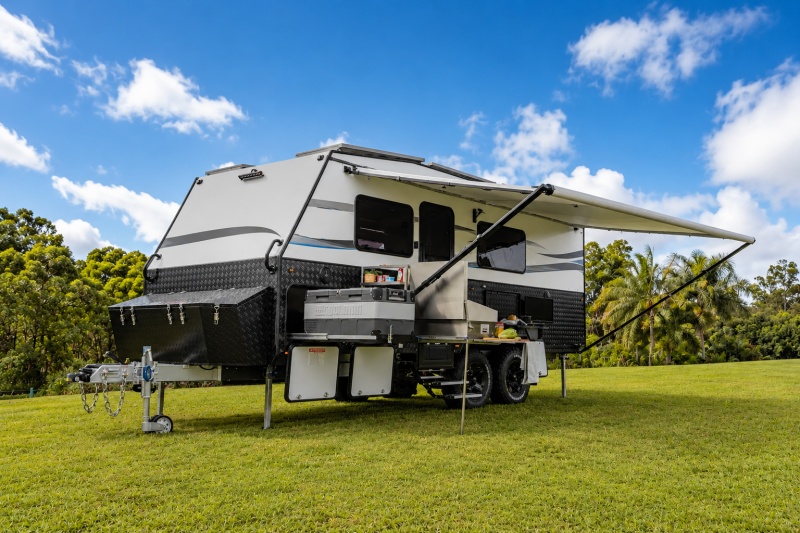
Dealers often see OEM caravan manufacturer and assume almost every detail can be changed.
Technically, many modifications may be possible.
Commercially, unlimited customization is not always a good idea.
If every production batch uses different:
Batteries
Inverters
Appliances
Furniture
Plumbing
Electrical components
Hardware
the dealer eventually has to support many different versions of the same caravan.
That can make spare-parts management and after-sales service more difficult.
A better approach is to customize the product strategically while maintaining standardized core components.
For distributors, the first order should ideally be considered in the context of a future range.
For example, a dealer may eventually require:
Compact Caravan
For couples or buyers who prefer a smaller towing platform.
Mid-Size Off Road Caravan
For buyers wanting additional interior space while maintaining manageable dimensions.
Family Off Road Caravan
For customers requiring more sleeping capacity, storage and living space.
The exact models depend on the target market.
The important point is that the supplier should support a coherent product range, rather than a collection of unrelated caravans.
A highly customized first caravan can look attractive, but it may create unnecessary complexity.
Starting from an established platform can make it easier to control:
Production
Cost
Weight
Component selection
Spare parts
Future repeat orders
Dealers can then customize the areas that create genuine market differentiation.
These may include:
Branding
Interior colours
Upholstery
Equipment package
Battery capacity
Solar capacity
Selected appliances
This approach can provide OEM differentiation without redesigning the entire caravan.
Many importers want to sell caravans under their own local brand rather than the factory brand.
Depending on the project, private-label requirements may include:
Dealer logo
Exterior graphics
Model names
Interior branding
Packaging
Documentation
These requirements should be confirmed before production.
Branding consistency becomes increasingly important when the dealer begins ordering several models.
Suppose a dealer orders the same model several times over three years.
Ideally, major components should remain reasonably consistent unless an approved upgrade or supply change is necessary.
Consistency can make it easier to manage:
Spare parts
Technician knowledge
Customer documentation
Warranty support
Inventory
For wholesale caravan programs, repeatability is part of product quality.
Supply chains change, and sometimes a component may become unavailable.
But a major substitution should not automatically be treated as insignificant.
Changing an inverter, battery, refrigerator or other component may affect:
Specification
Performance
Installation
Replacement parts
Customer expectations
For repeat dealer orders, major substitutions should therefore be communicated and confirmed.
Comparing two caravan quotations only by total price can be misleading.
Differences may exist in:
Chassis
Suspension
Battery capacity
Solar system
Appliances
Water tanks
Body construction
Interior materials
Optional equipment
A lower quotation may simply represent a different specification.
Dealers should therefore compare:
specification + manufacturing quality + support + price
rather than price alone.
Where commercial terms allow, an initial order can help an importer evaluate:
Product quality
Factory communication
Specification accuracy
Packaging
Shipping preparation
Documentation
Customer response
The purpose is not simply to inspect one caravan.
It is to determine whether the supplier is suitable for a repeat wholesale relationship.
For B2B orders, pre-shipment quality control can be organized around the approved specification.
Important areas can include:
Exterior condition
Interior finish
Doors and windows
Electrical functions
Plumbing
Appliances
Chassis equipment
Wheels and tyres
Ordered options
Dealer branding
Photographs and videos are useful, but a systematic inspection checklist provides better consistency for repeat orders.
A dealer's responsibility continues after the caravan is sold.
Customers may eventually require:
Pumps
Lights
Switches
Seals
Hardware
Electrical components
Plumbing parts
Running components
Dealers should identify which components are:
factory-specific and which can be sourced locally with appropriate specifications.
This can significantly simplify long-term service.
Importing every replacement component from China is not always practical.
For certain items, using components that have suitable local replacement options can reduce:
Customer downtime
Freight cost
Dealer inventory
When developing an OEM model, serviceability in the destination market should therefore be considered alongside the initial purchase price.
A warranty period is important, but caravan distribution is a longer-term business.
A dealer may need technical information or replacement parts after the original warranty period has ended.
For this reason, importers should evaluate:
Warranty terms
Spare-parts availability
Component identification
Technical communication
Repeat component supply
A sustainable dealer relationship requires more than a warranty statement on a quotation.
International caravan purchasing also involves logistics.
Dealers should understand factors such as:
Caravan dimensions
Shipping method
Destination port
Loading arrangement
Packaging or transport protection
Local inland transportation
Shipping cost can materially affect the dealer's landed cost.
It should therefore be considered when selecting both the model and purchasing quantity.
Destination-market requirements should be investigated before production.
Depending on the country, requirements may affect areas such as:
Electrical systems
Braking
Lighting
Coupling
Dimensions
Weight
Gas equipment
Road registration
Importers should verify applicable local requirements with appropriate authorities or compliance professionals.
A manufacturer's export experience does not automatically mean every configuration complies with every destination market.
Before establishing a wholesale relationship, ask:
Are you the manufacturer?
Which off road caravan models do you produce?
Which models are suitable for repeat dealer orders?
What OEM customization is available?
Can we use our own brand?
Which major components are standardized?
How are component changes controlled?
What quality-control process is used?
What spare parts can be supplied?
What warranty support is available?
What documentation is provided?
What is the production lead time?
What purchasing quantity is required?
What shipping options are available?
Can the same specification be reproduced on future orders?
These questions help distinguish a simple product quotation from a serious B2B supply program.
LZM focuses on supplying off road caravans for international dealer, importer and distributor projects.
Businesses looking for a China Off Road Caravan Manufacturer can review available caravan platforms and discuss OEM requirements according to their target market.
Rather than developing every unit as a completely different caravan, dealer projects can be structured around standardized models with selected customization.
This can help support:
Repeat production
Dealer branding
Product-range development
Component consistency
After-sales service
For dealers requiring a larger family-oriented platform, the 21ft Family Off Road Caravan can be evaluated as part of a broader dealer product range.
Depending on project requirements, discussions can include:
Interior layout
Sleeping capacity
Battery system
Solar equipment
Water capacity
Appliances
Dealer branding
Other OEM options
The final configuration should be developed according to the dealer's customer profile rather than simply adding every available option.
If you are a caravan dealer, importer or distributor looking for a long-term Chinese supply partner, useful information to provide includes:
Country and sales market
Existing caravan business
Required caravan sizes
Target retail customer
Preferred equipment level
OEM or private-label requirements
Initial purchasing quantity
Expected annual volume
This allows LZM to understand whether an existing platform is suitable or whether configuration changes should be discussed.
Finding a caravan wholesale supplier is not simply about locating the lowest factory price.
For dealers and importers, the more important objective is to establish a product range that can be manufactured consistently, branded locally, serviced after delivery and reordered as the business grows.
That requires coordination between product specification, quality control, component standardization, spare parts, logistics and OEM support.
For businesses sourcing from China, evaluating these capabilities can be far more valuable than comparing quotation prices alone.