Welcome: Laizhou Machinery Group



For many Australian off road caravan buyers, electrical capacity has become one of the most important product specifications.
Customers travelling between powered caravan parks may require only a relatively simple electrical system.
Customers planning remote or extended off-grid travel may expect enough battery and solar capacity to operate refrigerators, lighting, water pumps, electronics and other equipment without frequent access to external power.
For caravan dealers and importers developing an OEM product range, the question should therefore not be:
What is the largest battery we can install?
The better question is:
What electrical system is appropriate for the intended customer and equipment load?
Battery capacity, solar input, inverter output, charging capability and appliance selection should be considered as one complete system.
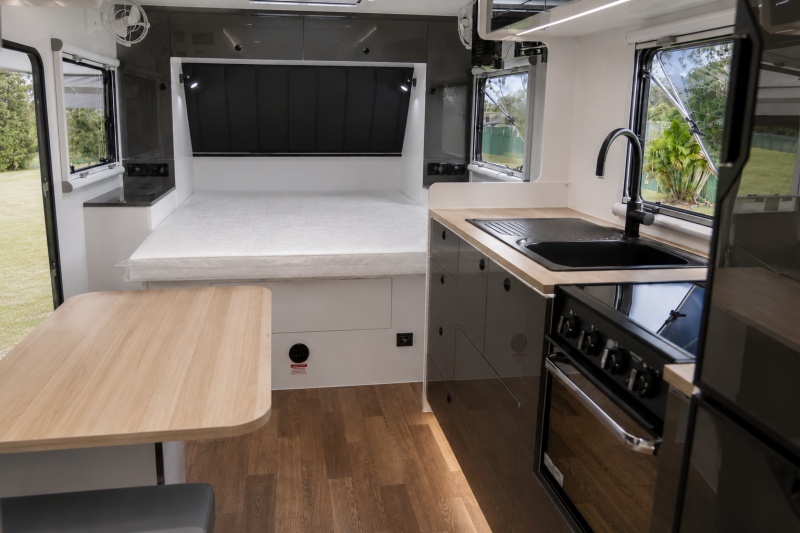
Before specifying batteries or solar panels, dealers should identify how the caravan will normally be used.
Important questions include:
How many days of off-grid travel are expected?
Will customers regularly use powered campsites?
Is air conditioning expected to operate from batteries?
What type of refrigerator is installed?
Will customers use induction cooking?
Are laptops, televisions or other electronics common?
What climate will the caravan operate in?
A caravan designed for weekend camping requires a different electrical system from one intended for extended remote travel.
There is no single battery capacity suitable for every caravan.
Lithium battery capacity should be selected according to expected daily energy consumption and desired off-grid duration.
Typical electrical loads can include:
Refrigerator
LED lighting
Water pump
Television
USB charging
Laptop charging
Fans
Kitchen equipment
Air conditioning
High-power appliances can dramatically change the required system.
For this reason, dealers should avoid comparing caravans only by battery capacity.
A larger battery does not automatically mean a better electrical system.
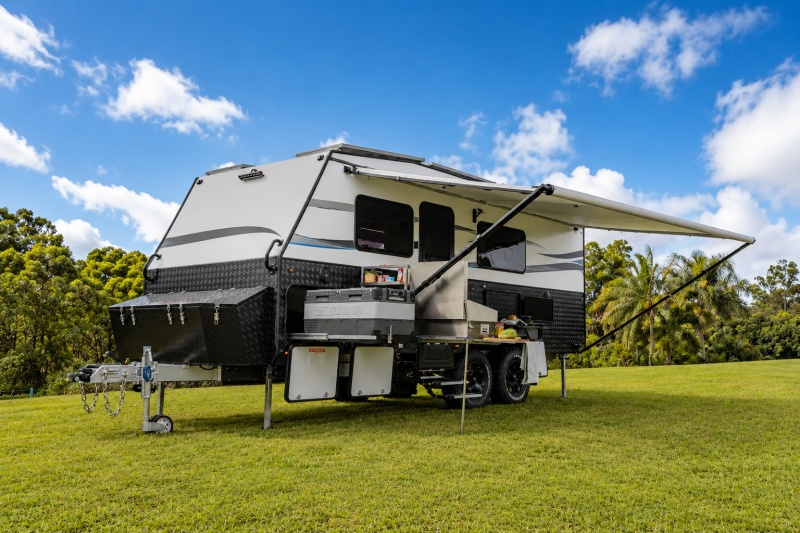
Lithium battery systems are commonly considered for off road caravans because they can provide advantages such as:
Higher usable capacity
Lower weight relative to some traditional battery solutions
Faster charging capability
Longer cycle life
Better suitability for larger off-grid systems
However, battery selection should also consider:
Battery management system
Charger compatibility
Operating temperature
Installation location
Ventilation and protection
Serviceability
For OEM projects, the complete electrical architecture should be confirmed rather than simply specifying a battery brand or capacity.
Solar capacity depends on several factors.
These include:
Battery size
Daily electricity consumption
Available roof area
Travel location
Seasonal sunlight
Other charging methods
A caravan with a large battery bank but insufficient charging capability may still experience energy shortages during extended off-grid use.
Similarly, installing more solar panels does not solve every problem if the customer's daily consumption is extremely high.
The battery and solar system should therefore be designed together.
Dealers should also evaluate:
Solar controller
Wiring
Protection devices
Battery charging limits
Panel installation
System monitoring
The objective is to create a balanced charging system rather than simply advertising a large solar wattage figure.
The inverter converts battery power into AC electricity for compatible appliances.
Required inverter capacity depends on the equipment that customers expect to operate.
Higher-power appliances may include:
Microwave
Coffee machine
Induction cooker
Hair dryer
Some air-conditioning systems
The inverter must be selected according to expected loads and startup requirements.
Installing an oversized inverter without considering battery capacity, cabling and system design does not automatically improve performance.
This is an increasingly common buyer question.
Technically, an appropriately designed battery and inverter system may support certain air-conditioning applications.
However, air conditioning consumes considerably more energy than lighting, water pumps or electronic devices.
Actual operating time depends on factors including:
Air-conditioner power consumption
Battery capacity
Inverter efficiency
Ambient temperature
Caravan insulation
Solar charging conditions
Other electrical loads
Dealers should therefore avoid promising a fixed number of air-conditioning hours without evaluating the complete configuration.
Lithium systems can become substantial when dealers specify very large capacities.
Additional electrical equipment may include:
Multiple batteries
Inverter
Chargers
Solar controllers
Cabling
Protection equipment
All of this contributes to vehicle weight.
Battery location can also affect weight distribution.
Electrical upgrades should therefore be considered together with:
Chassis capacity
Suspension
Payload
Water capacity
Other optional equipment
This is why electrical specification cannot be separated completely from caravan engineering.
Off-grid caravans may use several charging sources.
Depending on the design, these can include:
Solar charging
External mains power
Vehicle charging
Generator charging
For dealer projects, charging requirements should be confirmed before production so that the electrical system can be designed appropriately.
Not necessarily.
For dealers, offering several standardized electrical packages may be more practical.
For example:
Designed for customers who frequently use powered caravan parks.
Designed for customers requiring more battery and solar capacity for independent travel.
Designed for customers using additional electrical equipment and spending longer periods away from external power.
This approach can give customers choices without creating a completely different electrical system for every caravan.
When developing an OEM caravan range, electrical customization may include:
Lithium battery capacity
Solar panel capacity
Inverter specification
Charging equipment
Power outlets
Monitoring systems
Appliance packages
However, every upgrade should be evaluated as part of the complete caravan specification.
Dealers should also consider future servicing and replacement parts when selecting electrical components.
Before confirming an electrical specification, ask:
What lithium battery capacities are available?
How much solar can be installed?
What inverter options are available?
Can the system charge while towing?
Can customers use external mains power?
Can air conditioning operate from the battery system?
How are batteries protected and monitored?
How does the electrical package affect total caravan weight?
Can the same electrical specification be repeated in future orders?
Are replacement electrical components available?
These questions are more useful than comparing battery capacity alone.
LZM works with international caravan dealers and importers requiring different off-grid configurations.
Battery, solar, inverter and other equipment specifications can be discussed according to the caravan model and intended application.
For dealers evaluating different models and OEM configurations, explore the Off Grid Caravan Manufacturing Solutions:
https://www.lgloader.com/list/54-chinese-china-off-road-caravan.html
The 21ft platform can be discussed with different equipment configurations according to dealer requirements.
Depending on the project, specifications may include:
Lithium battery systems
Solar charging
Inverter options
Interior electrical equipment
Lighting
Appliances
Off-grid equipment
Dealers can review the 21ft Off Grid Family Caravan Option here:
https://www.lgloader.com/products/285-21ft-Off-Road-Caravan-For-Sale.html
If you are developing an off road caravan range for the Australian market, send us your intended customer profile and electrical requirements.
Useful information includes:
Caravan model
Typical off-grid duration
Main appliances
Required battery capacity
Solar requirements
Air-conditioning requirements
Expected purchasing quantity
LZM can evaluate the configuration together with the overall caravan specification rather than treating the battery system as an isolated option.
Battery capacity has become an important selling point in the Australian off road caravan market, but bigger numbers alone do not create a better caravan.
A properly designed system needs to balance battery storage, solar generation, inverter capacity, charging capability, appliance demand and total vehicle weight.
For caravan dealers, defining several practical electrical packages can make OEM products easier to sell, reproduce and support after delivery.